



Thesis by Noémie Auchère, winner of the 2025 Yves Chauvin prize: "Caractérisation des matières plastiques solubles en conditions normales de pression et température (PET et PVC) : déformulation nécessaire à leur recyclage avancé" (Characterization of soluble plastics under normal pressure and temperature conditions (PET and PVC): deformulation required for advanced recycling)
The development of advanced recycling methods for end-of-life plastics requires a detailed understanding of their composition. For feedstocks containing plastics destined for processing, it is particularly important to identify the polymers present, as well as the additives and contaminants they contain, in order to better understand their behavior during recycling and to support the development of appropriate processes.
The two end-of-life plastics that were the focus on this research, namely polyethylene terephthalate (PET) and polyvinyl chloride (PVC), are difficult to characterize because of the sheer diversity and number of additives and impurities they contain, sometimes in very low concentrations. The fact is that conventional analytical methods, which are often specific to and tailored for a particular chemical family of compounds, are not designed to handle such complex matrices. To address this challenge, deformulation methodologies need to be developed in order to isolate specific fractions (particularly polymers versus organic molecules), which can then be analyzed qualitatively and quantitatively on their own.
To this end, innovative strategies were developed combining extraction, chromatographic fractionation, liquid chromatography (LC), high-resolution tandem mass spectrometry (HRMS/MS), chemometrics, and molecular networks1. For PVC, the methods of size-exclusion chromatography (SEC) [1] and centrifugal partition chromatography (CPC) [2] were used to separate the additives. For PET, an accelerated solvent extraction (ASE) method, optimized using experimental designs, was developed and compared to dissolution-precipitation 2, which is commonly used as a reference method. These methodologies, which hitherto have rarely been applied to sorted PVC and PET batches, provide a more comprehensive characterization and, in particular, enable the identification of substances not really previously studied in these matrices (dyes, hazardous legacy additives, plasticizers, and other degradation products).
Moreover, the use of chemometrics, a statistical and mathematical method for identifying differences between samples and highlighting discriminating compounds, facilitated the characterization of the various deposits studied. The use of molecular networks to group compounds detected by LC-HMRS/MS based on their structural similarities then enabled their annotation3 and tracking during recycling (Figure 1).
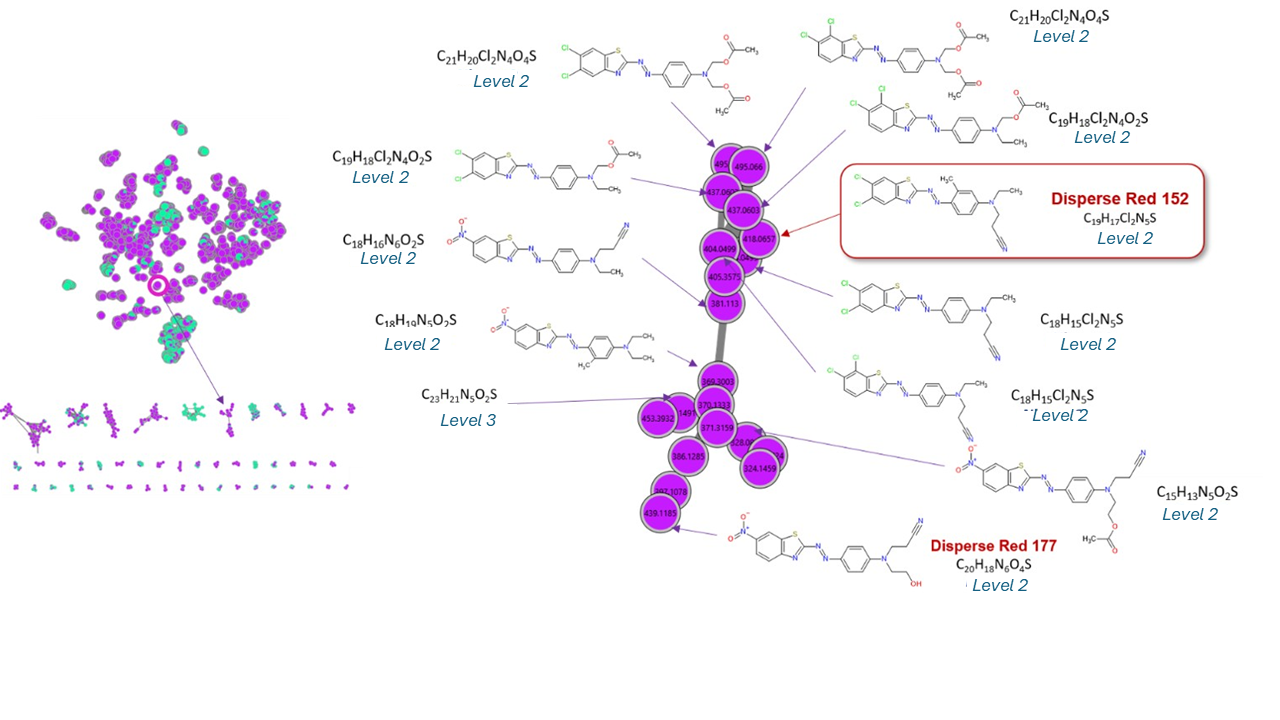
These developments open up new avenues for characterizing end-of-life plastics with a view to improving recycling processes. In particular, the proposed methodologies could contribute to the quantitative characterization of regulated compounds, be adapted to other matrices, and be applied in IFPEN’s research and innovation activities in this area. Furthermore, the data thus collected provide a reliable and well-established foundation for the development of new databases, which are already proving useful to the scientific community in the field.
1 An analysis and graphical visualization method used to organize large amounts of mass spectrometry data based on fragmentation models derived from tandem mass spectrometry.
2 The dissolution/precipitation process for a polymer involves dissolving it in a suitable solvent and then causing it to precipitate by altering the conditions of the medium in order to recover the polymer in solid form.
3 In mass spectrometry, annotation is the process of assigning a putative chemical identity or structural feature to an observed spectral peak, without verification against the reference substance.
4 Non-targeted analysis (NTA) is an analytical approach that involves detecting and characterizing as many compounds as possible in a sample, without recourse to a pre-defined list of target molecules.
References:
[1] N. Auchère, A. Berlioz-Barbier, A. Le Masle, A. Chaumonnot, Exhaustive characterization of polyvinyl chloride to support recycling processes by off-line two-dimensional size-exclusion chromatography coupled with reversed-phase liquid chromatography-high-resolution tandem mass spectrometry, Journal of Chromatography A, 1757 (2025), 466119
>> DOI : 10.1016/j.chroma.2025.466119
[2] N. Auchère, A. Berlioz-Barbier, A. Le Masle, O. Boyron, A. Chaumonnot, Centrifugal partition chromatography approach to separate additives from PVC resin to support recycling processes, Journal of Chromatography A, 1761 (2025), 466337
>> DOI : 10.1016/j.chroma.2025.466337
Scientific contact: Alexandra Berlioz-Barbier