



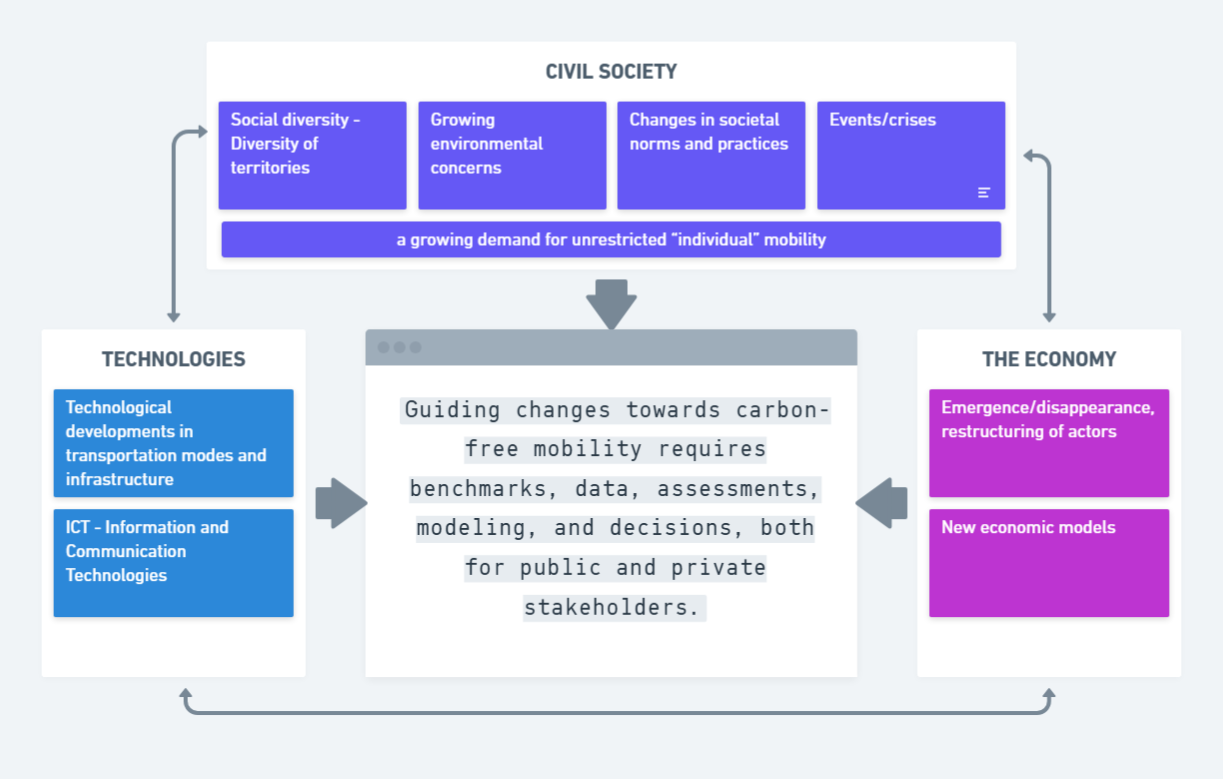
Co-led by IFP Energies nouvelles (IFPEN) and Gustave Eiffel University, the MOBIDEC “Digitalization and Decarbonization of Mobility” priority research program and equipment (PEPR) initiative is central to the France 2030 investment plan (Figure 1). This ambitious program is aimed at mobilizing national scientific excellence to bring about the sustainable transformation of the transport sector in France. Drawing on fundamental research (TRL1 1 to 4), MOBIDEC seeks to understand, anticipate, and simulate the mobility of goods and people in order to provide decision-making tools to public authorities and industrial players.
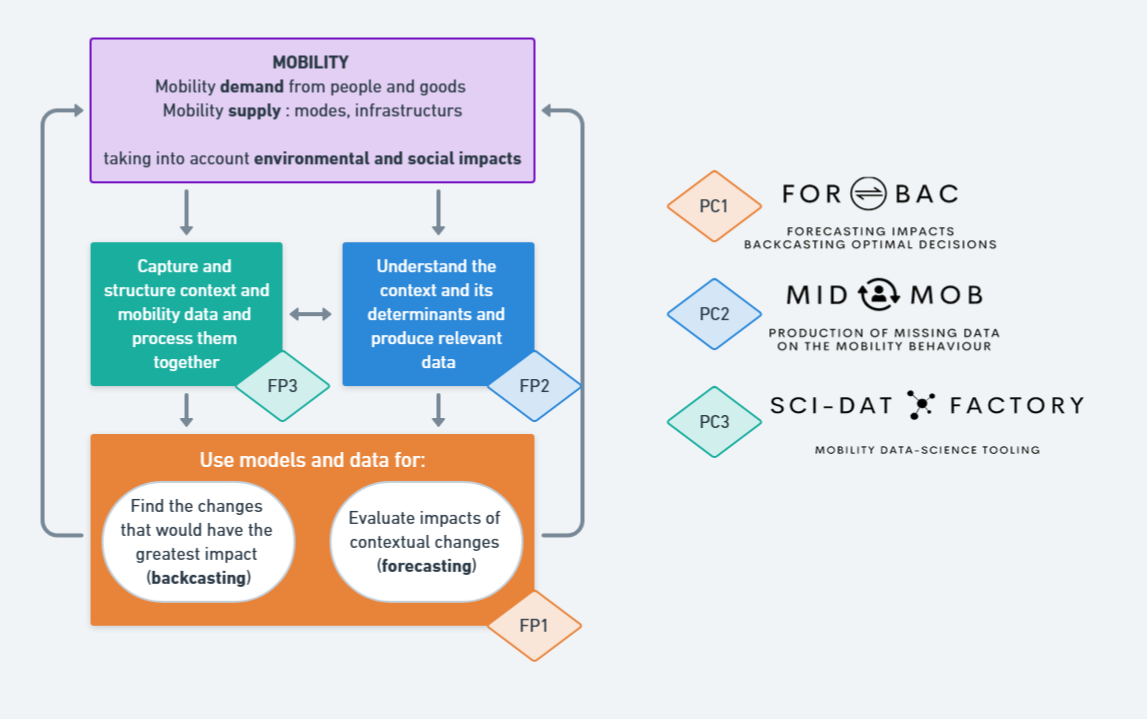
The program is hinged around three complementary areas supported by targeted projects (figure 2): FORBAC for impact forecasting and optimal decision-making, MiDMoB for generating data on individual behavior, and Mob Sci-Dat Factory, a technological platform dedicated to sharing mobility analysis tools.
Focus on the Mob Sci-Dat Factory: The mobility data “plant”
The Mob Sci-Dat Factory (2023-2027) project is co-led by IFPEN and Inria. The ambitious objective is to develop a secure platform for sharing and pooling resources aimed at researchers and experts in the field of mobility.
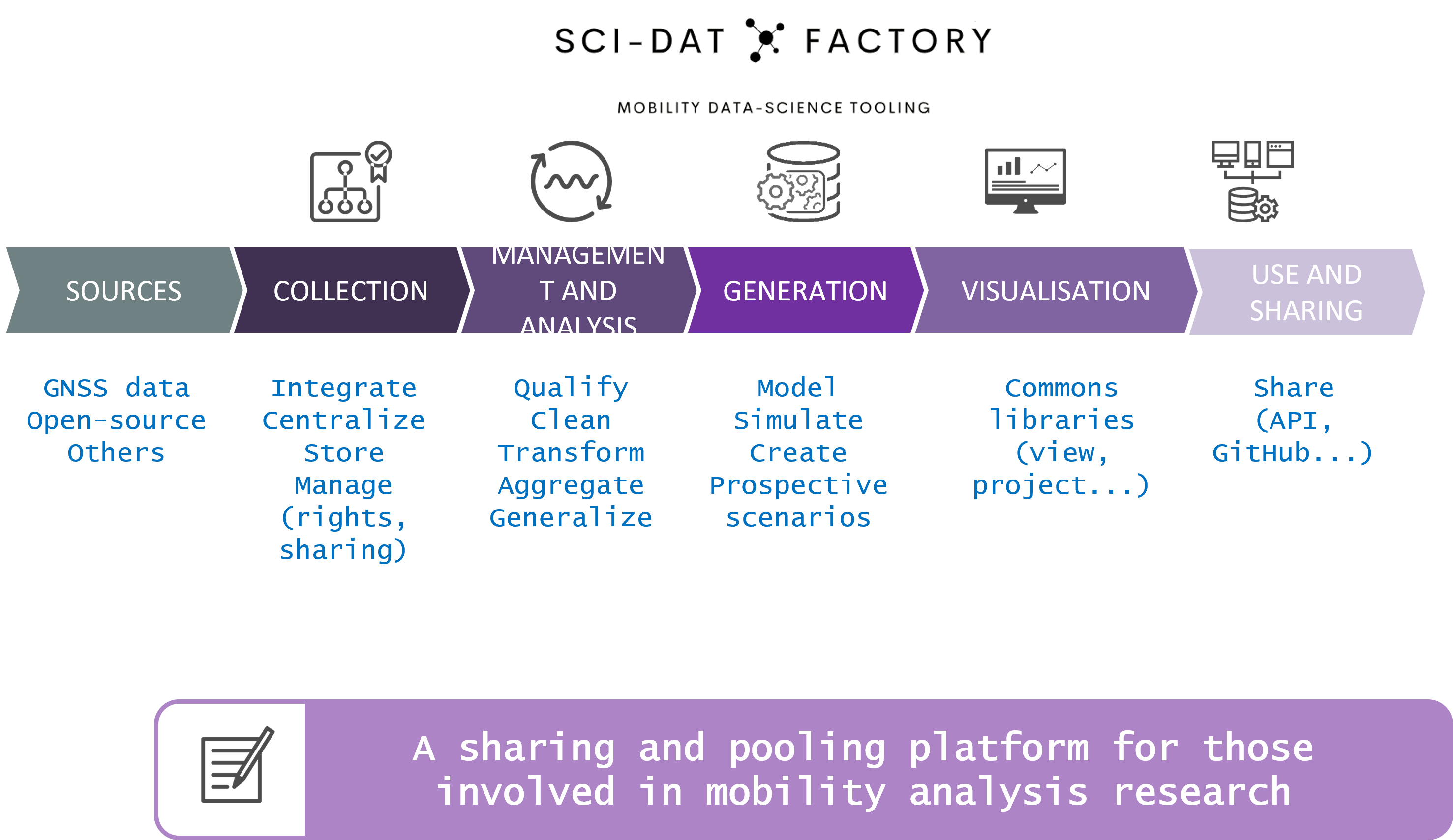
The challenge is not only to collect data, but to resolve complex issues related to their accessibility, heterogeneity, and quality. To this end, Mob Sci-Dat Factory hosts the development of tools designed to process, analyze, and extract useable knowledge from often fragmented masses of data (Figure 3).
A cutting-edge technological base
The platform is structured around an ecosystem of powerful tools enabling the automation of the data lifecycle:
- Secure collection and storage (GDPR compliant) and connections to existing data spaces2
- Automated data flow processing via Apache Airflow and Kubernetes
- Enrichment through models for visualization and calculation of transport accessibility indicators
- Community sharing via a dedicated portal, built with the two complementary environments - Huwise and CKAN - and also including a Discourse forum, a Wiki, code catalogues on GitHub, and community use of the platform.
A technological showcase: The NetMob25 Data Challenge
One of the project's key achievements is the NetMob25 Data Challenge.
This scientific challenge uses a massive GNSS3 dataset of 500 million points, covering the movements of more than 3,300 individuals in the Île-de-France region. This concrete example illustrates the platform's capacity to handle large volumes while ensuring data confidentiality. More than 60 international research teams are already using these resources to understand and analyze mobility and its impacts in the Île-de-France region.
IFPEN at the heart of of innovation
LIFPEN's involvement in Mob Sci-Dat Factory is testament to its combined expertise in data science and transport system modeling. Several PhD theses and post-doctoral research projects are underway at the institute as part of the PEPR initiative, focusing, for example, on deep learning for predicting urban traffic flows and the development of traffic simulation models such as MATSim.
By providing a common and scalable base, Mob Sci-Dat Factory does more than just deliver a finished product; it builds a scientific community capable of converting raw data into concrete levers for decarbonization, such as models and tools.
1 Technology Readiness Level : échelle employée pour évaluer le niveau de maturité d'une technologie
2 As the National Access Point to transport data (https://transport.data.gouv.fr/)
3 Global Navigation Satellite System
Scientific contacts: Alexandre Chasse, Gilles Corde