



Thesis by Sofiane Ferchichi : "Méthodes spectrales pour le suivi en ligne de procédés de recyclage de polyoléfines par dissolution/précipitation" (Spectral methods for online monitoring of dissolution-precipitation-based polyolefin recycling processes)
Given the increase in plastic waste and the limitations of conventional mechanical recycling1, in-solution chemical recycling offers a promising alternative because it makes it possible to produce high-quality materials through purification. However, it became apparent that real-time monitoring of dissolution was necessary to understand the mechanisms at work, to control them, and, ultimately, to optimize the process as a whole.
This PhD research led to the development of an integrated analytical methodology, based on in-situ spectroscopic techniques and advanced chemometric tools, to understand and optimize not only the dissolution but also the precipitation and separation of semi-crystalline polyolefins2. The approach focused on three main areas:
- methodological aspects: in situ monitoring and chemometrics
Raman and near-infrared spectroscopy measurements were performed at various temperatures on samples containing different concentrations of polyolefins, and chemometric models were then developed based on the spectra obtained. Testing these models on reference PE-PP systems demonstrated their capacity to monitor the dissolution [1], precipitation and thermal decomposition of polymers [2] in real time, irrespective of the temperature of the reaction medium or the type of solvent. Figure 1 shows the experimental setup used during the research, as well as an example of the Raman spectra obtained to monitor the dissolution of PP over time in four different solvents.
- elucidation of the fundamental dissolution mechanisms
The decrystallization of polymers by the solvent was studied. Differential scanning calorimetry (DSC) was used to classify the effectiveness of solvents based on polymer structure and to predict co-crystallization or selective separation behavior between PP and PE. These results were validated by Raman spectroscopy [3] and modeled3 using a kinetic approach based on diffusion, confirming the impact of polymer chain mobility on dissolution.
- application to real materials
Based on the methodologies and knowledge acquired, an in situ monitoring study was conducted on polyolefins representative of recycling centers. This experiment demonstrated that it would be possible to selectively separate polyolefins using a single solvent, simply by adjusting the precipitation temperature differences.
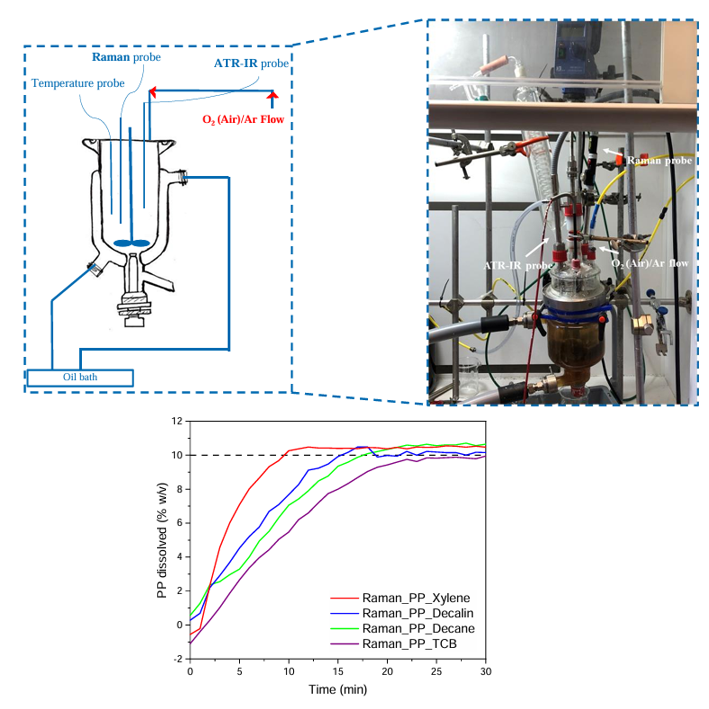
A comprehensive analytical strategy validated on representative samples is now available as a result of this research. It paves the way for robust and optimized control of chemical recycling processes for plastics.
1 Material degradation (loss of properties, limited number of cycles), challenges related to sorting and variability (complex/multilayer mixtures, color contamination, contaminants), and health and regulatory restrictions
2 Polyethylene (PE) and polypropylene (PP)
3 A kinetic model designed to simulate the dissolution of polyolefins as a function of structural and operational parameters (solvent viscosity, temperature, polymer molar mass, polymer topology, and boundary layer thickness)
References:
[1] S. Ferchichi, N.Sheibat-Othman, O. Boyron, C. Bonnin, S. Norsic, M. Rey-Bayle, V. Monteil, "In situ dissolved polypropylene prediction by Raman and ATR-IR spectroscopy for its recycling", Analytical methods: advancing methods and applications, pp. 3109-3117, 2024
>> DOI : https://doi.org/10.1039/d4ay00667d
[2] S. Ferchichi, N.Sheibat-Othman, O. Boyron, C. Bonnin, S. Norsic, M. Rey-Bayle, V. Monteil, "Monitoring Polypropylene Chain-Scission for Dissolution-Based Recycling by In Situ Near Infrared and Raman Spectroscopy Macromolecular rapid communications", 2025
>> DOI : https://doi.org/10.1002/marc.202400748
[3] S. Ferchichi, F. Collas, O. Boyron, C. Bonnin, S. Norsic, M. Rey-Bayle, V. Monteil, N.Sheibat-Othman, "Differential Scanning Calorimetry for Characterizing Solvent-Induced Decrystallization and Recrystallization of Polyolefins: Combination with In Situ Raman Spectroscopy", Macromolecular chemistry and physics, vol. 226
>> DOI : https://doi.org/10.1002/macp.202500088
Scientific contact: Maud Rey-Bayle