



One of the main challenges in computational fluid dynamics is to accurately represent physical phenomena at various scales of time and space. Furthermore, exact numerical resolution at every scale is very cost-intensive in terms of computation time. Obtaining reliable solutions therefore requires simulations performed on a coarse scale but using models capable of describing the effects of physics at a very fine scale. These models are useful, for example, in the study of combustion, where chemical reactions take place in extremely narrow regions called flame fronts, as well as in the study of turbulent phenomena and particulate flows.
There are many models based on physical laws, but their precision is generally limited for such applications because they rely on simplifying assumptions. A recent approach, enabled by advances in artificial intelligence, involves developing more accurate models through direct learning from reference data derived from highly detailed simulations, each carried out on small computational domains [1].
This new approach has been the subject of various studies at IFPEN, beginning in 2022 with the machine learning-based identification of drag force laws for suspended particles. This was followed by a similar approach for turbulence models in fluid mechanics [2].
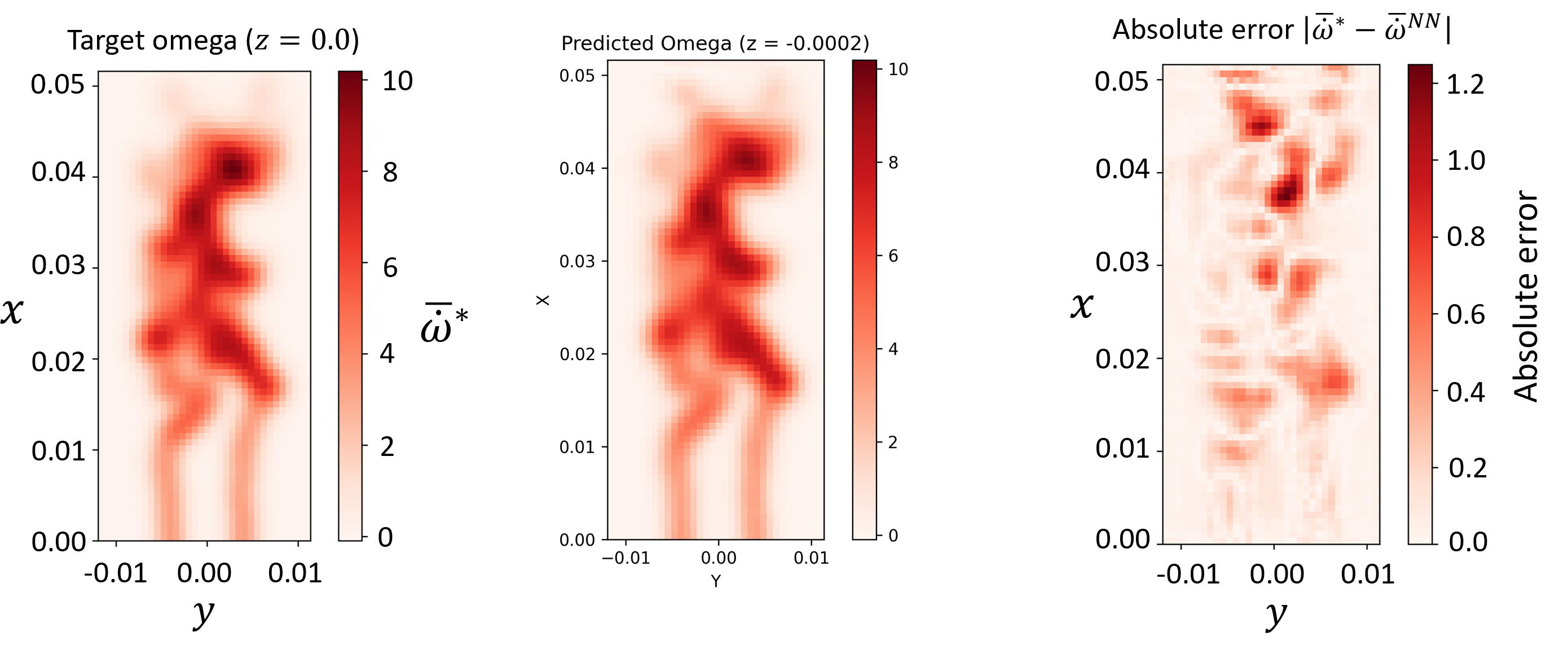
Very recently, exploratory research was conducted on a simplified case of turbulent combustion. A model based on a convolutional neural network (CNN)1 was trained using direct numerical simulations (DNS) of the flame and then used to predict the flame's behavior on coarser grids.
The results obtained are encouraging, as shown in Figure 1, which compares the exact reaction rateω (mol/s) with the model's prediction.
This ongoing research is currently the focus of an IFPEN/ONERA PhD thesis launched in 2026 [3].
1 Deep learning architecture specialized in processing grid-structured data, such as images
References:
[1] Sanderse, B., Stinis, P., Maulik, R., & Ahmed, S. E. (2025). Scientific machine learning for closure models in multiscale problems: A review. Foundations of Data Science, 7(1), 298–337.
>> DOI : https://doi.org/10.3934/fods.2024043
[2] Vital, E. et al. (2025), Neural Network for Subgrid Turbulence Modeling for Large Eddy Simulations. Proceedings of ParCFD 2025 conference,
>> DOI : https://arxiv.org/abs/2511.05103.
[3] Flament, C., Thèse ONERA/IFPEN: Modélisation du plissement de sous-maille par apprentissage automatique pour les simulations aux grandes échelles de la combustion turbulente prémélangée. [Modeling submesh wrinkling using machine learning for large-scale simulations of turbulent premixed combustion].
Scientific contacts: Cédric Mehl, Thibault Faney