


01.09.2026
15 minutes of reading



As energy challenges intensify, numerical modeling and artificial intelligence are becoming essential tools for understanding complex phenomena and designing new systems. This special issue features six scientific briefs that draw on the expertise of researchers from the “Digital Science and Technology” Division, who are developing innovative tools and methods to address the strategic and environmental challenges of the future, working on various scales and using complementary approaches.
The first article concerns numerical models dedicated to air quality, examining phenomena ranging from the micro-urban level to the regional scale to identify factors that influence air quality and guide local and strategic decision-making. Next under the spotlight is the issue of geological CO2 storage: simulations, safety concerns, and technical prospects help shed light on the conditions necessary for reliable and responsible deployment. Wind turbine control at IFPEN exemplifies the combination of physics-based control and machine learning, with a focus on reinforcement learning, which promises to optimize wind farm production and sustainability. More broadly, artificial intelligence is being incorporated into closure models for multiscale computational fluid mechanics, providing solutions to reduce approximations and improve the precision of predictions. Electromobility is examined from the perspective of optimal design methodology for charging infrastructure, taking into account optimization, usage, and regional constraints. Finally, generative AI methods for the design of catalytic microstructures demonstrate how the algorithm accelerates the discovery of high-performance materials.
There is a common theme running through all these briefs: the integration of physical models, data, and algorithms to address complex societal challenges. They illustrate how IFPEN researchers, working closely with industry partners and decision-makers, are harnessing digital science and technology to support the energy and ecological transition by deploying innovative solutions.
We hope that you enjoy this issue.
Mongi Ben Gaid, Giovanni De Nunzio, Thibault Faney, Jean-Marc Gratien, Stéphane Jay, Jean-François Lecomte, Jordan Rudloff, Antonio Sciarretta, Delphine Sinoquet, Quang Huy Tran,
Scientific advisors of the "Digital Science and Technology" Division

Air quality around the street corner: the contribution of numerical models
Air pollution remains a major public health issue, particularly in large metropolitan areas, despite the gradual renewal of the vehicle fleet and the development of active mobility solutions, thanks to dedicated urban infrastructure. New European limit values for pollutant concentrations in the air, more closely aligned with WHO recommendations, will take effect in 2030. Local authorities therefore need tools capable of assessing pollution levels and sources in order to support pollution reduction scenarios.
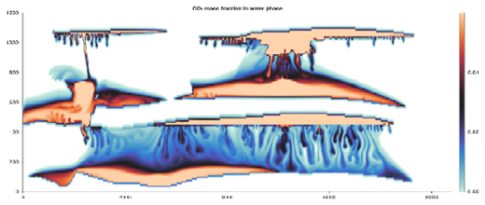
Geological storage of CO₂: Geoxim compares favorably with other numerical simulators
The SPE11 benchmark study, conducted under the auspices of the Society of Petroleum Engineers (SPE), brought together teams of researchers from universities, research organizations, and companies specializing in geological CO₂ storage [1]. The purpose of the project was to compare the performance of numerical simulators designed for this particular application. Based on test cases with common input data and evaluation criteria, the study analyzed the ability of calculation codes to reproduce the main physical processes at play in the injection and migration of CO₂ in geological reservoirs.

The use of wake-effect modeling to optimize wind farm production
To maximize energy production and streamline operations, operators are designing wind farms that incorporate an increasing number of turbines. However, under certain wind conditions, wind turbines frequently interact through what is known as the wake effect. The wake is created behind the rotor as it intercepts the wind's kinetic energy to convert it into electricity. Due to the conservation of energy, a zone of low wind speed develops, accompanied by increased turbulence.

Artificial Intelligence in Multiscale Computational Fluid Dynamics
One of the main challenges in computational fluid dynamics is to accurately represent physical phenomena at various scales of time and space. Furthermore, exact numerical resolution at every scale is very cost-intensive in terms of computation time. Obtaining reliable solutions therefore requires simulations performed on a coarse scale but using models capable of describing the effects of physics at a very fine scale.
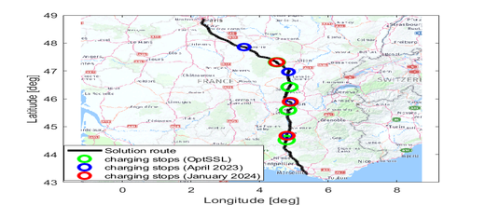
Towards more robust planning of charging infrastructure for electric vehicles
The increase in the number of electric vehicles requires the rapid and efficient deployment of EV charging stations (EVCS), since drivers are reluctant to “take the plunge” while the charging network is seen as being inadequate. At the same time, operators are unwilling to invest without a guaranteed financial return. Yet the widespread adoption of electric vehicles, along with the need to balance supply and demand, requires that charging stations be strategically located, particularly along major highways.

Catalyst supports designed using generative AI
The performance of a catalyst support — whether alumina or zeolite — depends on the properties of its porous microstructure: porosity, specific surface area, and the connectivity of the solid network, which govern the access of reactants to active sites. Designing an optimal support thus amounts to solving an inverse problem, i.e., identifying the microstructure, and then the manufacturing parameters, that satisfy a set of property specifications.