



Thesis by Jérémie Creux : "Contribution au suivi de l’état de santé des machines synchrones à aimants permanents - Détection précoce de défauts de désaimantation localisés et caractérisation hautes fréquences du stator" (Contribution to the monitoring of the condition of permanent-magnet synchronous motors - early detection of localized demagnetization defects and high-frequency characterization of the stator)
As with propulsion systems, the current transition in the transport sector is driving the replacement of hydraulic and mechanical actuators with electric motors, particularly permanent-magnet synchronous motors (PMSMs). One of the main challenges of this rapid technological transformation is therefore to ensure the availability and performance of these electrical energy conversion systems.
However, with rising power supply voltages, increasing switching frequencies1 and decreasing available volumes, all the components of electrical power conversion systems are subjected to significant electrical, mechanical, and thermal stresses, which can lead to failures. Among the risks involved, this research focused on two degradation phenomena that are particularly harmful to traction PMSMs: the demagnetization of the permanent magnets in the rotor and the aging of the insulation in the stator windings. The goal was to identify aging indicators based on reliable and meaningful defects, while developing the tools needed to monitor them.
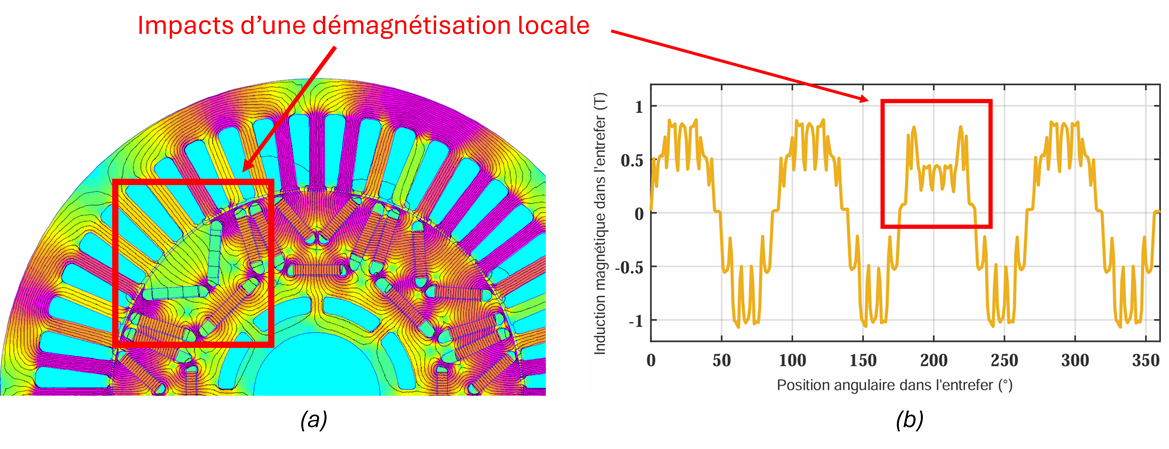
To understand the demagnetization phenomena in PMSMs, a finite-element numerical model [1] of several automotive traction motors was developed (Figure 1.a). It makes it possible to simulate their behavior in the presence of local demagnetization (Figure 1.b). The characteristic signatures of such defects, depending on the type of winding, the number of pole pairs, and the rotor design, were then identified [2].
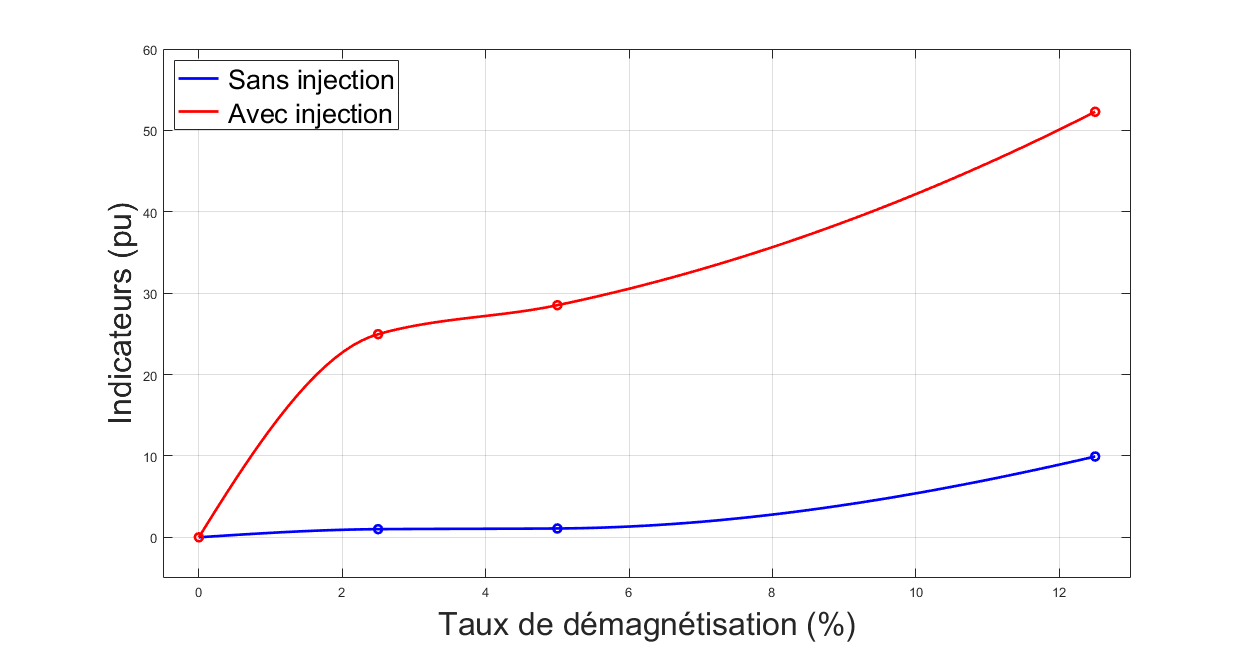
As a result, a targeted harmonic excitation strategy, via machine control, was devised to experimentally detect low-severity demagnetizations [3]. The test results then showed an increase in the signal-to-noise ratio (Figure 2), enabling more reliable defect detection, while lowering the detection thresholds [4].
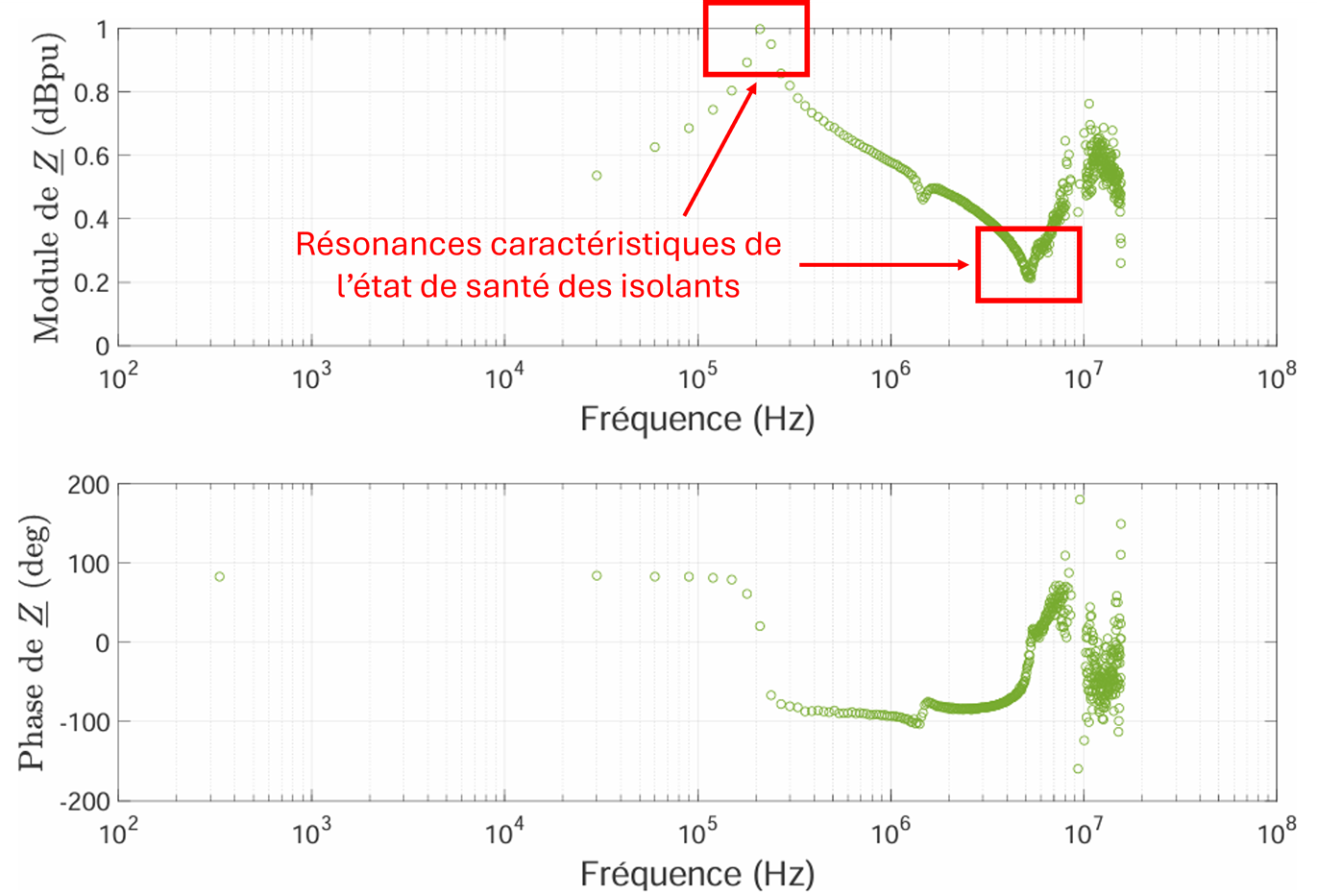
With regard to insulation systems, the correlation between their quality and the frequency response of the stator windings is a well-documented phenomenon. In embedded applications, it is therefore essential to monitor the condition of the insulation to detect any deterioration at an early stage, without removing the motor from its operating environment. An original approach was adopted to address this challenge. It is based on the natural harmonic excitation of the windings when they are powered by a voltage inverter controlled via pulse-width modulation (PWM)2. The proposed method makes it possible to reconstruct a Bode plot of the impedance3 behavior of the windings (Figure 3) and, consequently, to evaluate the magnitude and frequency of the first two resonances, which are characteristic of the condition of the insulation [5,6].
Future research will focus on integrating these two strategies into real-time monitoring systems, including the diagnosis and predictive maintenance of the conversion systems under consideration.
1 The switching frequency refers to the rate at which an electronic switch rapidly turns on and off to modulate an electrical signal
2 A technique used to generate a pseudo analog signal from a digital or analog environment to enable that signal to be processed by switch-mode components
3 The degree to which a circuit, a component (winding, capacitor, transformer), or a material resists the flow of alternating current
Reference :
[1] J. Creux, N. Haje Obeid, T. Boileau, et F. Meibody-Tabar, "Local Demagnetization Fault Detection in PMASynRM based on Finite Element Modeling and Characterisation", IECON 2022 - 48th Annual Conference of the IEEE Industrial Electronics Society, Bruxelles, Belgique, 2022.
>> DOI : 10.1109/IECON49645.2022.9968829
IEEE Industrial Electronics Society Best Conference Paper Award
[2] J. Creux, N. Haje Obeid, T. Boileau, et F. Meibody-Tabar, "Comparative Behavior Study of Various PMSM Topologies Under Demagnetization Conditions", International Conference on Electrical Machines (ICEM), Turin, Italie, 2024.
>> DOI : 10.1109/ICEM60801.2024.10700367
[3] J. Creux, N. Haje Obeid, T. Boileau, et F. Meibody-Tabar, "PMASynRM Local Demagnetization Fault Behavior Study Under Targeted Harmonic Excitation", 2023 IEEE Industry Applications Society Annual Meeting, Nashville, USA, 2023.
>> DOI : 10.1109/IAS54024.2023.10406862
Scientific contacts: Najla Haje Obeid, Jérémy Creux