


Focus on...

IFPEN
Events
18 - 19 March 2024
Fluid-solid flows with anisotropic particles : final MUSCATS workshop
Innovation and Industry
News
14 September 2023
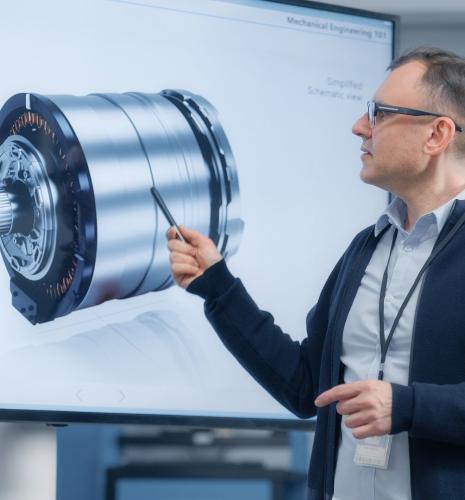
Electric machines and recyclable magnets: cutting-edge technologies to save material
The IFPEN Transports Energie and Énergies du futur (CEA-Liten) Carnot Institutes pooled their expertise for the Melchior project (Machines électriques dans une chaîne de valeur orientée vers le recyclage, or Electric Machines in a Recycling-Oriented Value Chain), conducted from 2022 to 2023 and aimed at developing an electric machine prototype based on recyclable magnet technology. This prototype significantly reduces the quantity of magnets habitually used and its innovative architecture facilitates recycling while guaranteeing excellent performance.

News in brief
Towards a new generation of power converters to optimize electric powertrains
In electric vehicle powertrains, it is necessary to convert the DC voltage supplied by the battery into three-phase AC voltages to power the vehicle's electric motor. This conversion is carried out by the vehicle's on-board power electronics, known as an inverter. This inverter is also responsible for controlling the electric motor, varying its speed or torque (...) These voltage drops, be they intrinsic or of external origin, will reduce the performance of the machine in question. Initially, this PhD research made it possible to study and model in detail the physical phenomena behind intrinsic voltage drops in converters....

News in brief
Towards more explicit energy consumption for more efficient electric vehicles
To maximize the contribution of hybrid electric vehicles (HEV) to the decarbonization of the transport sector, their energy performance is a key factor that needs to be considered from the design phase. For an HEV, optimizing the design in order to reduce consumption involves not only optimizing a sizing aspect but also the EMS. This co-optimization of sizing and energy management is generally tackled either by nesting optimal control algorithms within an optimization algorithm dedicated to sizing, or by using convex optimization to simultaneously optimize the design levels. However, the former approach is known to induce computational constraints (for example relating to calculation time), while the latter can affect modeling fidelity due to the constraints inherent in convex optimization...

News in brief
Magnets for future generations of electric vehicles
Permanent magnet synchronous motors (PMSM) are a reference technology for electric vehicle propulsion. However, their large-scale deployment is subject to the constraints associated with magnets: the capacity to obtain resources as well as the environmental challenges related to mining, recycling and refining. In addition, PMSMs often require flux-weakening1 strategies in order to operate at high speeds, which can result in energy losses...

News in brief
Power electronics at the heart of electric mobility challenges
In the case of electrified vehicles, whether battery-powered (electric or hybrid) or powered by fuel cells (FC), power electronics (PE) converters play a major role, as they are used for a variety of functions. For example, they are used to drive electric motors, manage on-board energy or control traction battery recharging...
News in brief
Electrical machines: Design, optimization, control and diagnosis
Like all sectors concerned by electrification, the transport sector requires the design of high-performance, efficient electrical systems that respond to multiple constraints, such as cost and compactness. In this context, optimisation has become an essential step in the design process of these systems, particularly for electrical machines...

News in brief
SC1 - New experimental set up to study battery safety
The electrification of mobility is a major transformation aimed at reducing greenhouse gas and pollutant emissions by the transport sector. In this context, the Li-ion battery is currently the technology employed by all car manufacturers to provide the energy storage required for the roll-out of electric vehicles...
News in brief
The 48-volts system: mild hybrid with significant potential
Electrification of the vehicle powertrain is one of the keys to sustainable mobility and hybridization with internal combustion engines is becoming increasingly common. In this context, the “48-volt” mild hybrid system is a low-cost, flexible and easy-to-integrate option, with reduced safety constraints and outstanding performances.
News in brief
Ignition simulation
In order to reduce fuel consumption in gasoline engines, manufacturers are focusing their efforts on turbocharging and downsizing. However, this option leads to an increase in the knock phenomenon
News in brief
Energy in vehicles: we’ve got it under control!
In hybrid vehicles, onboard algorithms are aimed at splitting power between the various energy sources in order to minimize fuel consumption and/or pollutant emissions. This real-time management