




Karst formations are complex networks of underground passages resulting from the dissolution of rock, which can extend for hundreds of kilometers. Their reaction to climate change is crucial given their importance in freshwater supply (affecting around 20% of the world's population), but also their role as a buffer against extreme weather events, which are set to become more frequent. Flash floods can occur, for example, when all the conduits are saturated, with all the associated consequences. Furthermore, in terms of transporting pollutants, the presence of conduits can have a significant influence on when they arrive in inhabited areas, significantly impacting the ability to mitigate the consequences.
The KARST project is a six-year project funded by the ERC1 as winner of the 2022 Synergy call for proposals aimed at collaborative projects between academics. The partners (IDAEA- CSIC2 Spain, Ljubljana and Neuchâtel universities, IFPEN) are led by four PIs3 affiliated with these entities, respectively Marco Dentz, Bojan Mohar, Philippe Renard and Benoit Noetinger, whose areas of expertise complement each other4.
The aim of the project is to build digital models of these karst systems, characterize their networks by mapping them, and then describe the flows at various scales, from the conduit to the network as a whole.
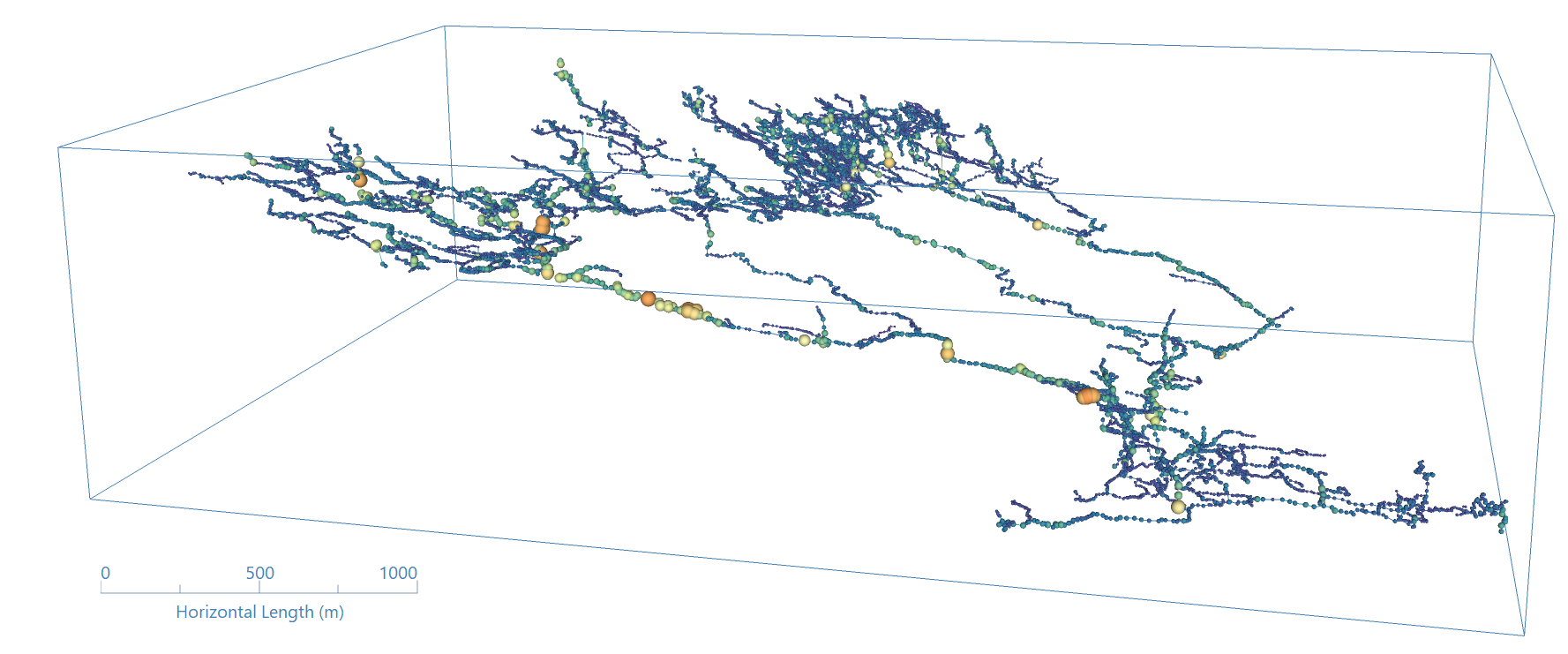
The idea, therefore, is to be able to characterize these networks by mapping them, and to describe the flows at both conduit level and network level. The approach adopted is multi-scale, ranging from the characterization of individual conduits, their network, their coupling with the surrounding rock, and external forcing phenomena. Ultimately, the partners are also interested in the genesis of these networks in order to find relevant descriptors relating to their spatial organization.
At IFPEN, flow experiments are conducted by the Mobility and Systems Division on 3D-printed models, which are scaled-down versions of actual conduits scanned using LIDAR5 techniques. The velocity fields and flow rate/pressure loss relationships are measured and compared with the results of numerical simulations (CFD6) performed on the same conduits. A preliminary conclusion is that the empirical models hitherto used by researchers in numerical simulation, which are based on smooth, straight conduits, are actually not at all precise in the case at hand.
Another team, in the Environmental Science and Technology Division, is looking at how runoff is handled throughout the network, taking into account the uncertainties associated with a lack of exhaustive data. This component of the research draws on IFPEN's expertise in scaling, derived from flow models in aquifers and oil reservoirs, and applies it to conduit networks. On a large scale, these networks can be described using graphs, i.e., a network of nodes representing the intersections between conduits, connected by links whose conductivity aggregates the influence of the characteristics of the conduit in question (length, diameter, roughness, tortuosity, etc.).
This then requires the resolution of large linear systems, with associated matrices that are linked to conduit conductivities. However, these conductivities are poorly understood because they are difficult to measure in the field. It is therefore necessary to propose reliable estimators through a process of averaging. To this end, formulas for calculating average conductivity have been established in the form of power laws whose exponent depends on the connectivity of the underlying conduit network [1]. Ultimately, it turns out that the effective conductivity of a relatively isolated conduit is “averaged” using a harmonic mean7; however, in the case of a highly connected conduit, a simple arithmetic mean is more appropriate. These techniques make it possible to disregard uncertainties related to imperfect knowledge of the conductivity of all conduits.
Furthermore, in order to simplify calculations, model reduction was applied using spectral methods8, which allow network nodes to be aggregated without resorting to the concept of spatial proximity. The ultimate goal of this component of the project is to link up with the “black box” models used by field operators, which are sufficient for routine use but not very predictive during the extreme weather events covered by the KARST project.
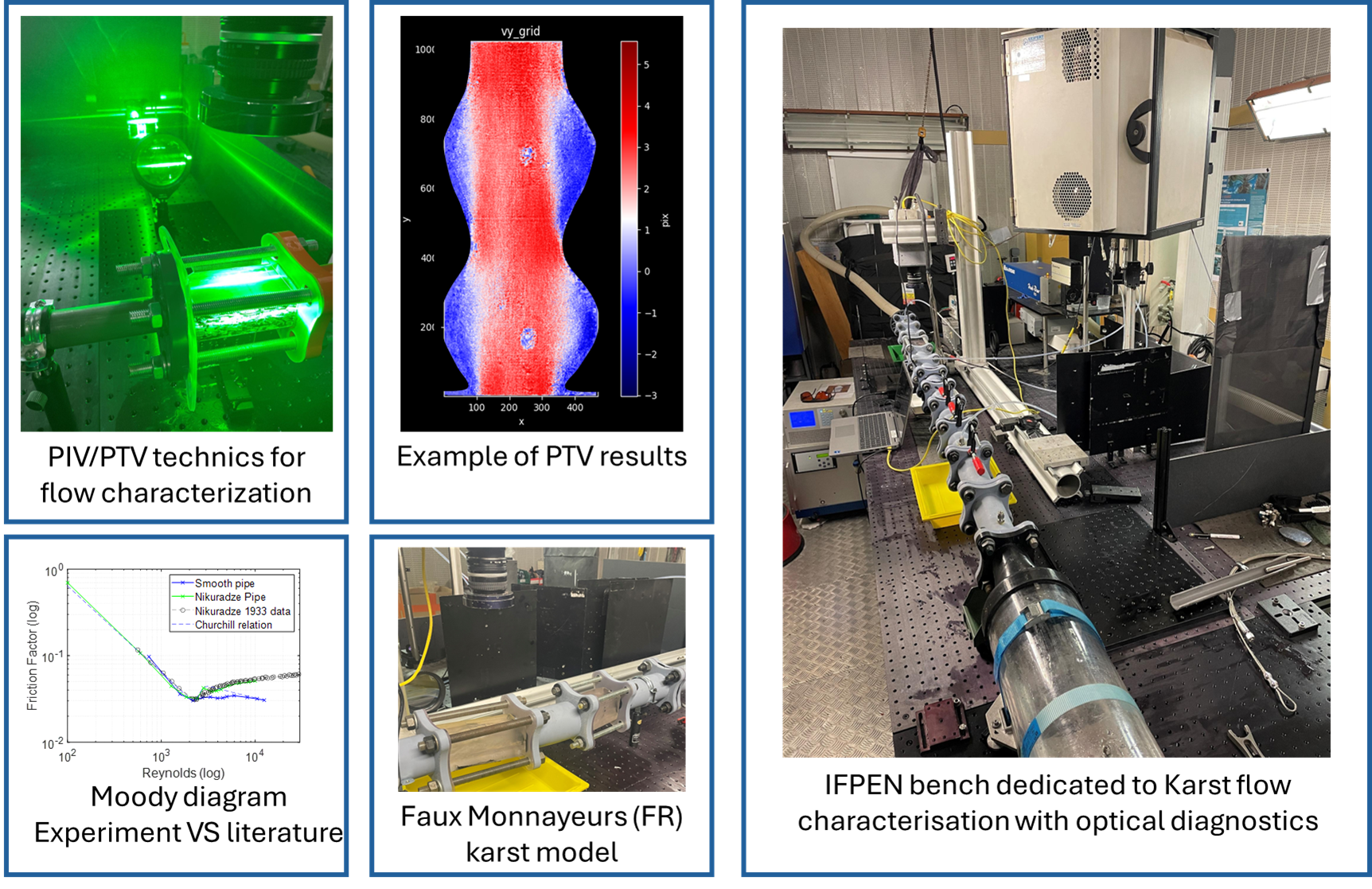
Understanding conduit formation is another aspect of the research that will draw on IFPEN's recognized expertise in analog modeling to ultimately produce physical karst models in the laboratory.
Finally, the project results will be implemented “in the field”, in close collaboration with the K3 project and the GeEAUde chair, of which IFPEN is a partner.
In summary, the KARST project brings together researchers from different countries and scientific cultures over a long period of time and with resources appropriate to the research challenges involved. Beyond the collaborative aspect, the project gives IFPEN the opportunity to host two doctoral students and postdoctoral researchers, while developing dedicated experimental resources, such as original flow visualization techniques. Short-, medium-, or long-term scientific visits by one team to another have enriched exchanges and sometimes led to original solutions to scientific questions. The synergy effect between teams is paying dividends.
1 European Research Council
2 Institute for Environmental Assessment and Water Research - Spanish National Research Council
3 Principal Investigators (PI)
4 Transport in geological flows, graph theory, field geosciences and modeling, scale change
5 Laser imaging, detection et telemetry
6 Computational Fluid Dynamics
7 Average calculated by taking the reciprocal of each value, finding the arithmetic mean of these reciprocals, and then taking the reciprocal of the result.
8 These methods involve focusing on the eigenvalues of these matrices, which can be estimated very quickly using modern methods. It is shown that the smallest eigenvalues correspond to large-scale flow variations, which are of most interest to us in this project. These techniques enable the optimal grouping of nodes.
Reference:
[1] Colecchio, I., Le Gall, E., & Noetinger, B. (2025). Effective conductivity of conduit networks with random conductivities. Physical Review E, 112(1), 014309.
>> DOI : https://doi.org/10.1103/wb8q-xv3x
Contact scientifique : Benoît Noetinger