



Thesis by Daniel Mimouni : "Multistage Stochastic Optimization: From Optimal Transport-Based Scenario Tree Reduction to Robust Optimization"
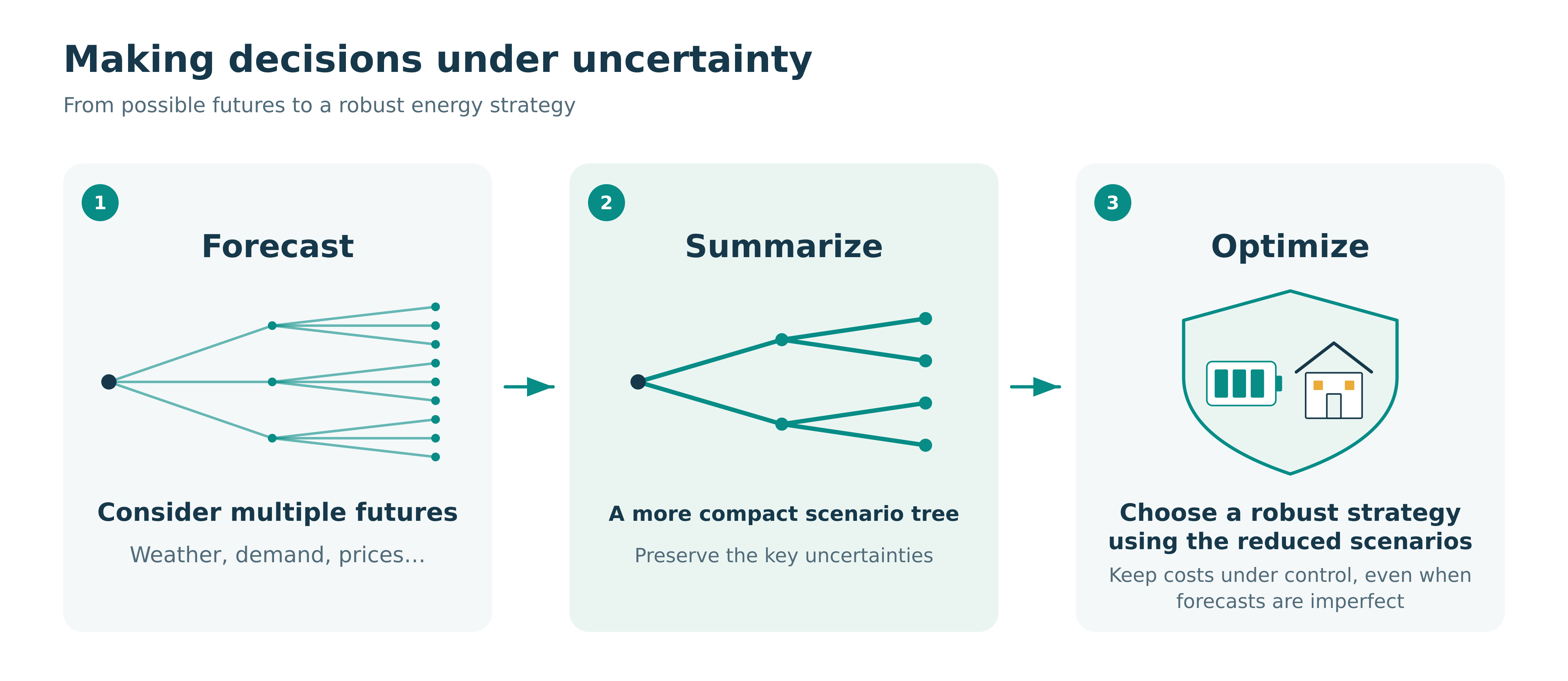
The energy transition requires the large-scale integration of renewable energy sources, some of which are intermittent in nature. To maintain balance across power grids, energy management systems need to continuously make decisions within the context of an uncertain future (weather, consumption). Such uncertainties can be modeled by scenario trees, which mathematically map all possible futures. To faithfully represent reality, these trees must incorporate a large number of scenarios. However, the more scenarios there are, the more complex it becomes to determine the optimal decisions. It is therefore essential to reduce the size of these trees while maintaining their statistical accuracy.
The Kovacevic and Pichler (KP) algorithm is an existing reduction method that allows a large tree to be summarized into a smaller one, while preserving its temporal dynamics (filtering). However, its main algorithmic bottleneck is the repeated calculation of a very large number of Wasserstein barycenters1, a mathematical task that is often too intensive for conventional computer solvers.
To address this problem, this research introduced MAM (Method of Averaged Marginals), an innovative algorithm specifically designed to calculate these barycenters accurately and quickly. Its integration into the KP algorithm led to a nine-fold reduction in computation times while maintaining optimal accuracy. As a result, it is now possible to use a large, realistic tree as a basis for rapidly constructing a reduced yet faithful version (Figure 1). This solution to the original problem, which is computationally efficient and therefore suitable for industrial deployment, already features extensions (constrained and unbalanced barycenters) designed to address the physical constraints of industrial systems.
These contributions were integrated into a comprehensive stochastic optimal control framework and resulted in the deployment of a software suite, which was validated using a stationary battery system operated by IFPEN. The management system can now anticipate and optimize its strategies with an unprecedented degree of robustness and speed, demonstrating the industrial relevance of these methodological advances.
Ongoing research is aimed at improving the performance of the MAM algorithm, particularly through its implementation on graphics processing units (GPUs), enabling massive parallelization of computations. It will also focus on the stochastic optimization of very large multi-agent systems, for which scenario reduction will play an important role. Beyond the energy sector, the robustness of these mathematical tools paves the way for new approximation methods for complex physical simulations and the modeling of large-scale dynamic systems.
1 A probability measure representing the geometric mean of several other probability measures, minimizing the weighted sum of the squared Wasserstein distances
References:
[1] D. Mimouni, W. de Oliveira, and G. M. Sempere. "On the computation of constrained Wasserstein barycenters", Pacific Journal of Optimization, 2025.
[2] D. Mimouni, P. Malisani, J. Zhu, and W. de Oliveira. "Computing Wasserstein barycenters via operator splitting : The method of averaged marginals", SIAM Journal on Mathematics of Data Science, 6(4) :1000–1026, 2024.
[3] D. Mimouni, P. Malisani, J. Zhu, and W. de Oliveira. "Scenario tree reduction via Wasserstein barycenters", arXiv preprint arXiv :2411.14477, 2024.
[4] D. Mimouni, J. Zhu, W. de Oliveira, and P. Malisani. "A comparative study of multi-stage stochastic optimization approaches for an energy management system", arXiv preprint, 2025.
Scientific contacts: Paul Malisani, Jiamin Zhu