



Thesis by Adrien Ingles: "A Near-Wall Model for Heat Transfer Prediction in Laminar Flows at High Prandtl Number: Application to Impinging Liquid Jet for Electric Motor Cooling"
Electric vehicle powertrains are evolving toward more compact designs with higher rotational speeds, which results in significant heat flows within confined spaces. Direct oil-jet cooling is a promising solution that effectively targets the most critical areas. However, due to the thermal and rheological properties of the oils used (high Prandtl numbers1: Pr>150), the thermal boundary layer2 is very thin, particularly in the jet’s impact zone, where cooling is greatest. In CFD (Computational Fluid Dynamics), explicitly modeling this boundary layer requires very fine meshes and often results in prohibitively long computation times.
In order to avoid explicit resolution of the thermal boundary layer, a near-wall thermal model, adapted to fluids with a high Prandtl number and laminar flows, was developed [1,2]. The model, implemented in the Converge code, is based on Lévêque’s analytical solution [3] and makes it possible to estimate the wall heat flow from the local temperature, without the need to solve additional equations.
This approach was applied to the cooling of an electric machine winding head combining five oil jets. Figure 1 shows the formation of the oil film and the presence of very high heat flows in the jet impact zones.
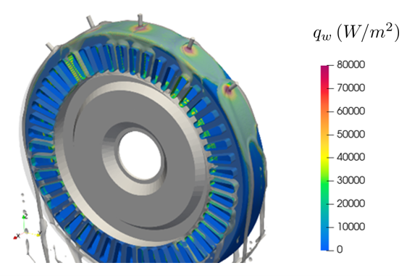
This model makes it possible to perform previously inaccessible “high-Pr” simulations, while containing the heat transfer error3: below 10% over most of the domain and limited to 25% locally, in areas where the flow exhibits more complex dynamics. Research is ongoing to improve the model's accuracy in these areas. The model will then be extended to include rotor cooling, where the centrifugal effect significantly thins the oil film, and to take into account surface roughness (irregularities are of the same order of magnitude as the thickness of the thermal boundary layer, i.e., a few tens of micrometers).
Ultimately, more reliable prediction of hot spots will make it possible to better cool sensitive parts of the motor and increase its power density.
1 A dimensionless number (ratio of thermal diffusivity to kinematic viscosity) that compares the speed of and hydrodynamic phenomena in a fluid
2 A fluid region in contact with a solid surface where the temperature varies significantly due to heat transfer
3 Compared with calculations for cases that can be performed using the conventional approach
References:
[1] Ingles A., Poubeau A., Vinay G., Nicoud F. "A near-wall model for heat transfer prediction in laminar flows at high Prandtl number." Computers & Fluids (2026)
>> DOI : https://doi.org/10.1016/j.compfluid.2026.107137
[2] Ingles A., Poubeau A., Vinay G., Nicoud F. "A Near-Wall Model for Heat Transfer Prediction in Laminar Flows at High Prandtl Number with variable viscosity: Application to Electric Motor Cooling. Computers & Fluids" (submitted)
[3] Lévêque A. "Les lois de la transmission de chaleur par convection." (The laws of heat transfer by convection) Annales des Mines 13 (1928)
Scientific contact: Adèle Poubeau