

27.07.2026
2 minutes of reading


 Many applications in the process industry deal with fluids that contain electrolytic species. The industrial surveys that have been conducted by the Industrial Task Force of the EFCE (European Federation of Chemical Engineering) Working Party on Applied Thermodynamics pointed to the need to promote development in electrolyte thermodynamics, and showed how important this issue is for industry: while thermodynamic models for neutral molecules are now well established, there are still many unanswered issues related to the presence of ions in a fluid mixture.
Following points can be listed to illustrate the still unanswered issues related to the presence of ions in a fluid mixture:
- No agreement in the scientific community about the best model to use for combined long range and short range interactions,
- The industrial models used to date often have a very large number of parameters.
- Several phases may coexist (several liquids in addition to vapour and several solids). This implies a rigorous phase stability analysis.
- In mixed or non-aqueous solvents, the speciation (chemical species) may be very different from that observed in pure water.
- Considering the complexity of the industrial systems, the data are often insufficient, meaning that data extrapolation methods may be needed.
This is the reason why the JIP ELETHER was launched.
- Scope and objectives of the JIP
- Some feedbacks from EleTher2
- Some results
- Scientific learnings from JIP
- Additional scientific learnings from other IFPEN research activities
- References
Scope and objectives of the JIP
The EleTher JIP is designed to create an industrial community that aims at promoting collaboration between academia, software vendors and industrial users.
This project has several goals:
1. Identify the key challenges faced by industrial applications in electrolyte thermodynamics
This was obtained by investigating specific case studies that are all based on following quaternary system:
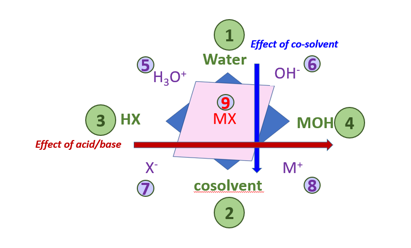
The salt MX is a combination of an acid (HX) and a base (MOH), that both form ions when dissolved in a high dielectric constant (permittivity) medium as water. When a cosolvent is added, the permittivity of the medium decreases, and the relative strength of the acid and the base changes. If the cosolvent does not react, the quaternary system therefore becomes in fact a system with nine components. Changing the concentration of the acid or the base affects the pH of the system, while changing the concentration of the non-aqueous solvent affects the permittivity and thus the ionic strength.
2. Promote collaboration between industry, software vendors and academia in view of solving these challenges
The selection of thermodynamic models is often motivated by the availability of the model in process simulators. This is why, in the second edition, the outcome of the JIP is strongly influenced by the discussions with the three participating software vendors, AspenTech, Fives-ProSim and Hafnium Labs.
In addition, contact with the academic community was promoted through publications, participation in conferences and seminars as well as webinars.
3. Propose best practices
In order to have an operational model, following workflow needs to be followed:
- Data search and validation [4, 5],
- Extrapolation of the data to process condition using physically-sound understanding,
- Parameterization of the empirical model using pertinent data [5].
Some feedbacks from EleTher2
The second edition of EleTher is now terminated and the partners have expressed their impressions as shown below.
Here are the main comments from users of the models.:
• A key interest in the EleTher Project is the collaboration with different software vendors, and the continuous exchange on their modelling methodologies.
• The use of different properties used together in the parameterization procedure was of great interest.
• “It is good not to feel alone”. The meetings are very fruitful, and more specifically the yearly seminars that last longer, where one can go into more details
• eNRTL is the “powerhorse” of the electrolyte modelling, but its parameter degeneracy is a true issue.
• Liquid-liquid phase split is an important industrial problem. From the discussion, it appears that the speciation behaviour in the water-poor organic phase is very different from that in the aqueous phase, which is a problem that is not often looked at.
As for the software providers, here are their impressions:

• New models will be implemented (eUNIQUAC, eCPA, eSAFT).
• Regarding the regression approach, the strategy for multi-objective parameterization should be further developed, as well as the use of pseudo-data.
• The definition of the model, its sub-models, and the properties/parameters needed was found a key issue for a good communication.
• Among the learnings of the project is that we should further encourage academia to further pursue the understanding of ‘simple systems’
• The project has been an eye-opener for some issues as the Henry constant mixing rule
• It is very difficult to have a correct representation of the liquid-liquid partitioning with the conventional non-reactive (fully dissociated of non-dissociated) assumptions.
Some results
- The ATOMS webinar aimed at explaining some fundamental concepts that are needed for analyzing the various kinds of data.
- Some open access publications are also available that illustrate the collaborative work achieved [4,6].
- An open webinar series was initiated, with the purpose of reaching out to the academic community.
- The first webinar was proposed in January 2025, by Prof. C Chen: « Industrial Challenges with Electrolyte Thermodynamics ».
- The second webinar, in January 2026, was led by Prof C. Held on the topic « Electrolyte thermodynamics of mixed-solvent systems and the importance of pH in chemical reactions ».
Scientific learnings from JIP
The main outcome of the work can be illustrated on a ternary diagram. It states that using a same model is to describe properties in both aqueous and non-aqueous solvents, the difference between strong and weak salts is completely blurred. In practice, all salts must be considered reactive.
As the thermodynamic properties are computed from chemical potentials, each compound must have its own. The analysis of the solvent chemical potentials and that of the solutes imply using different properties.
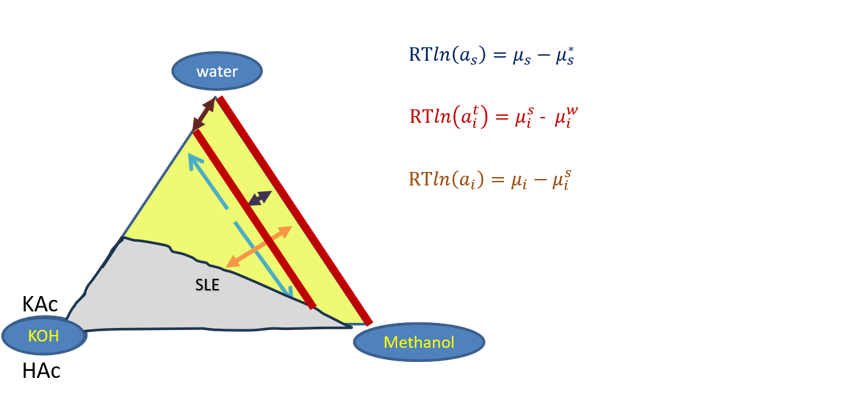
The data can be split into three categories, one that is sensitive to the solvent chemical potential, and two for the solute (salt) chemical potentials. For solutes, some data point to the impact of the solvent itself, and other to the impact of the solutes concentration (which can be high):
• For the solvent chemical potentials, phase equilibrium data are sufficient.
• For the solute chemical potentials at infinite dilution in a given solvent, the Gibbs energies of transfer can be deduced from spectroscopic or conductivity data.
• The impact of concentration on the solute chemical potential is expressed using potentiometric or solid crystallization data.
In order to calibrate an industrial model completely, the three categories of data must be considered in the objective function, yielding a multi-objective optimization. Most approaches use a single objective function where several types of sub-functions are added without considering their respective impact. The LAGUN open source software allows visualizing the individual contribution of each sub-function.
The work was performed using one specific model (eNRTL). Strengths and weaknesses of that model have been identified.
Additional scientific learnings from other IFPEN research activities
In parallel of the JIP, IFPEN research on electrolyte thermodynamics (EleTher) continues with the finalization of a PhD work that showed how the ePPC-SAFT model can be used successfully to describe salts in aqueous and non-aqueous mixtures [7, 8]. The model has a physical foundation and aims at representing the different intermolecular interactions that can be found in such fluids, as also discussed by Novak et al. [9]. The work has shown, for example, how the salt chemical potential difference values can be decomposed in contributions from different interactions.
1. Intermolecular contributions for the impact of salts on solvent chemical potentials
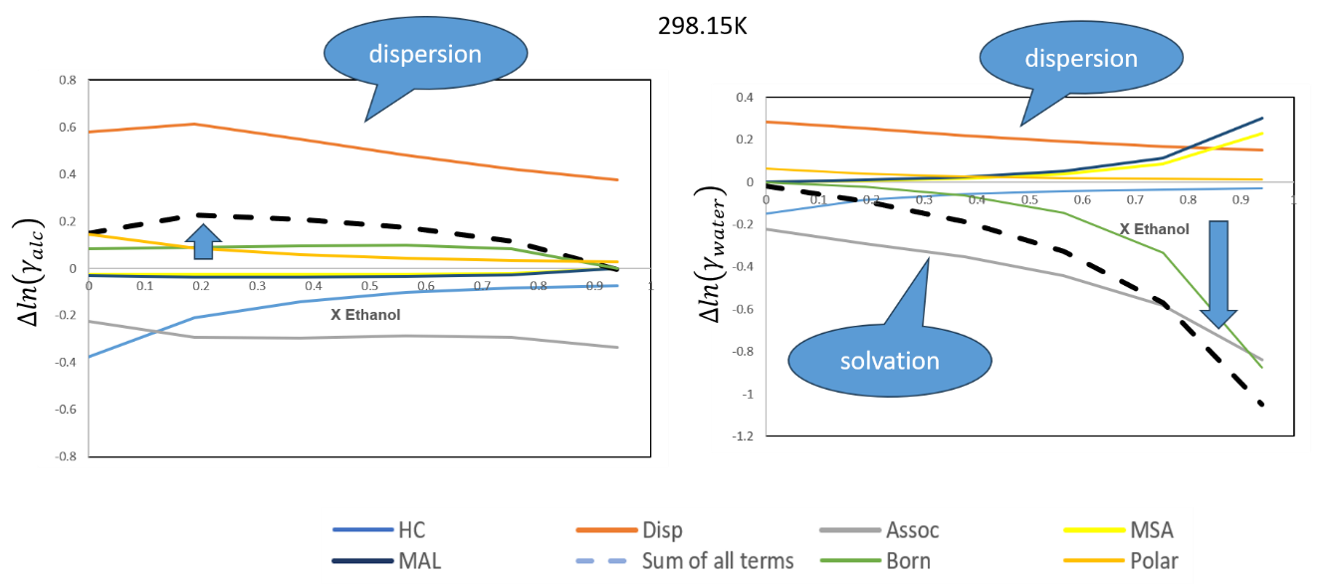
2. Intermolecular contributions for the solute chemical potentials at high concentrations
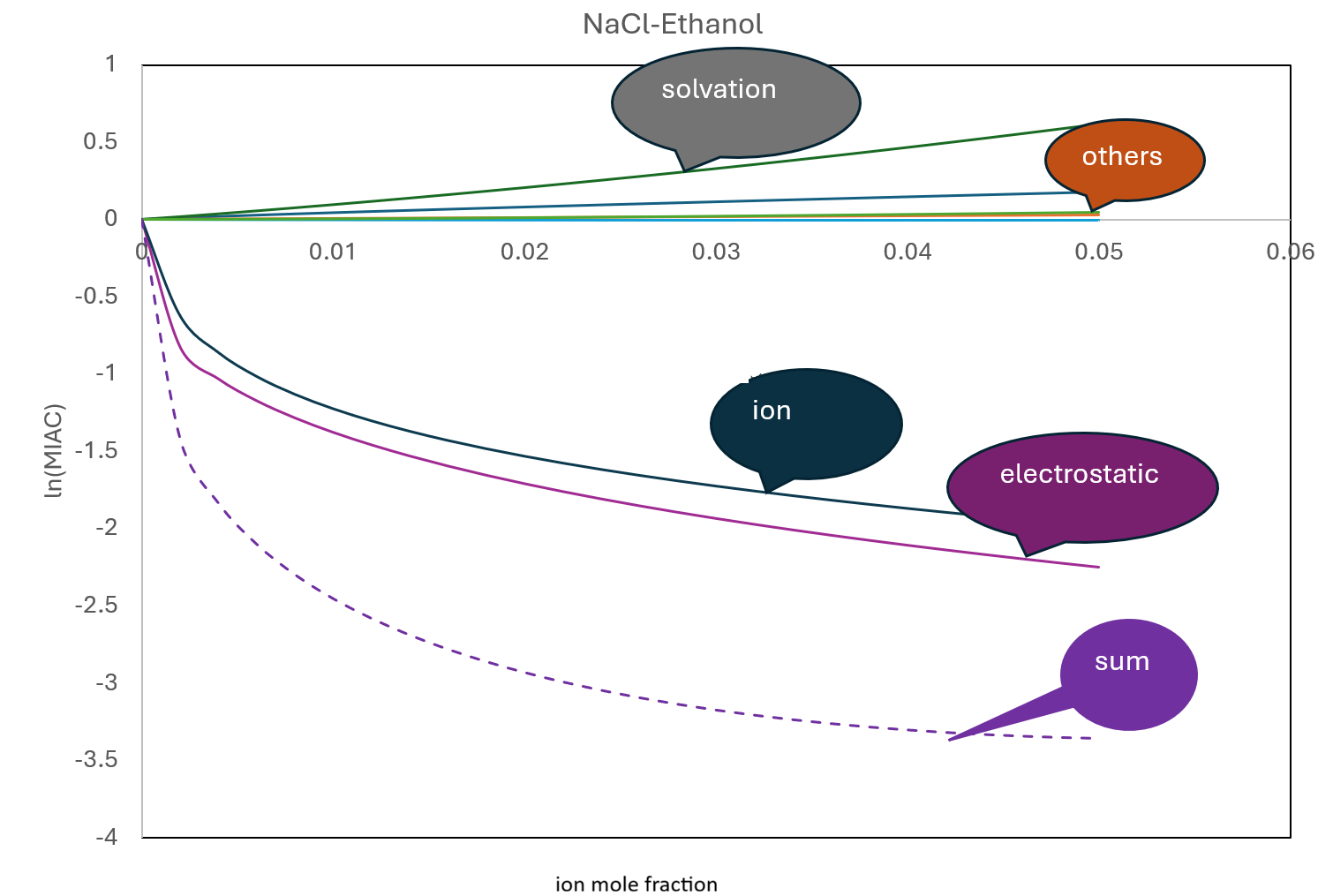
Figure 2 : Contributions of the terms to ln(𝛾±) for sodium chloride in pure ethanol,
calculated using the WS, BS, BT, and BgT models at 0.1 MPa and 298 K (hard-chain [HC] in blue, dispersion [Disp] in orange,
association [Assoc] in gray, polar in gold, Born in green, MSA in yellow, and MAL in dark blue).
3. Intermolecular contributions for solutes as a function of concentration
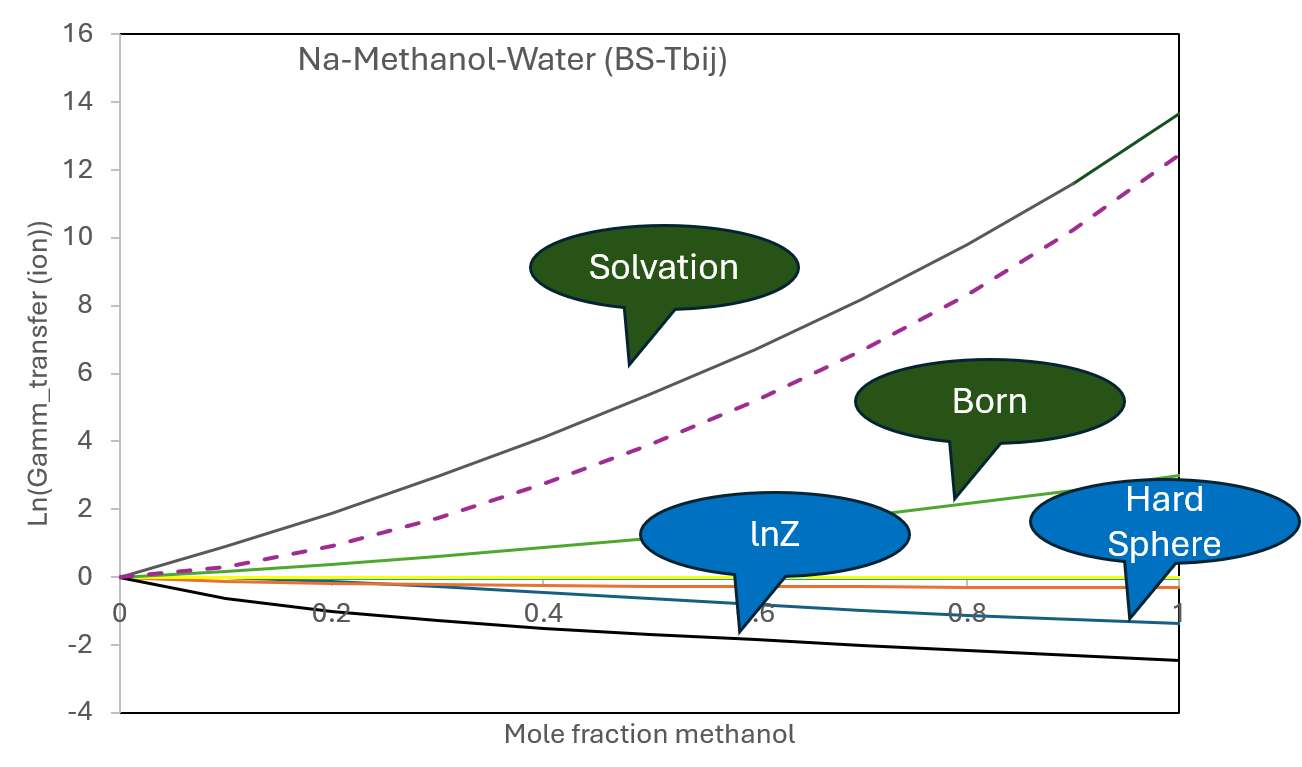
Figure 3 : Contributions to ln(𝛾tr) of the terms related to Na+ and Cl- in a water-ethanol mixture according to the BT-Tbij model,
at 0.1 MPa and 298 K (Hard chain (HC) in blue, dispersion (Disp) in orange, association (Assoc) in gray, polar in gold,
Born in green, MSA in yellow, and MAL in dark blue).
Further work is expected on this issue with the start of a new PhD work on the use of an equation of state in hydrometallurgy.
References:
[1] Kontogeorgis et al.: Industrial Requirements for Thermodynamic and Transport Properties - 2020, Ind Eng Chem Res, 60, 4987-5013
>> DOI : https://doi.org/10.1021/acs.iecr.0c05356
[2] de Hemptinne et al.: A view on the future of thermodynamics - 2022, Ind. Eng. Chem. Res. 61 (2022) 14664–14680.
>> DOI: https://doi.org/10.1021/acs.iecr.2c01906
[3] Kontogeorgis et al.: Conclusions from Round Table Discussion during IUT of ESAT 2021 electrolyte thermodynamics challenges - From industrial needs to academic research, 2022, Fluid Phase Equilibria, 556, 113399
>> DOI : https://doi.org/10.1016/j.fluid.2022.113399
[4] Vaque A. et al.: Data analysis for electrolyte systems: a method illustrated on alkali halides in water (2021), J. Chem. Eng. Data Vol 66/8, p 2976-2990
>> DOI: https://doi.org/10.1021/acs.jced.1c00105
[5] Yang et al.: A Benchmark Database for Mixed-Solvent Electrolyte Solutions: Consistency Analysis Using E-NRTL (2022), Ind. Eng. Chem. Res. 61 (2022) 15576–15593
>> DOI : https://doi.org/10.1021/acs.iecr.2c00059
[6] Maghsoodloo et al.: Thermodynamic Modeling of Mixed Solvent Electrolyte Solutions: Challenges and Practical Guide, J. Chem. Eng. Data (2025) Vol. 70/1
>> DOI: https://doi.org/10.1021/acs.jced.5c00412
[7] Raeispour Shirazi et al.: Thermodynamic modeling of aqueous and mixed-solvent alkali chloride solutions using an ion-pairing equation of state, 2024, Fluid Phase Equilibria, vol 588, 114231
>> DOI: https://doi.org/10.1016/j.fluid.2024.114231
[8] Raeispour Shirazi et al.: Improved ion-pairing equation of state and its use for various property calculations, 2025, Fluid Phase Equilibria Vol 595, 114396
>> DOI: https://doi.org/10.1016/j.fluid.2025.114396
[9] Novak et al.: Contributions to Ionic Activity Coefficients: A Review and Comparison of Equations of State with Molecular Simulations, 2025, Fluid Phase Equilibria , vol 594, 114339 1. Impact of salts on solvent chemical potentials
>> DOI: https://doi.org/10.1016/j.fluid.2025.114339

You may also be interested in