


12.10.2026
3 minutes of reading


The Real-Fluid Model (RFM), developed at IFP Energies nouvelles (IFPEN), is an approach employed in compressible fluid mechanics to describe real fluid flows under complex thermodynamic conditions: high pressures, subcritical, supercritical1 and transcritical2 conditions, as well as phase changes. The advantage of the approach lies in the integration of a compressible, multicomponent description of the flow, a real-fluid equation of state (EoS)3, and a vapor–liquid equilibrium (VLE) calculation.
History and development of the RFM
RFM was initially developed (Figure 1) in the context of high-pressure and transcritical injection modeling, particularly for applications in internal combustion engines. A key step was the development of a fully compressible two-phase model based on four equations (mass, momentum, energy, and species balances), under assumptions of mechanical, thermal, and thermodynamic equilibrium. In addition, thermodynamic closure, a VLE calculation procedure used to determine thermodynamic properties and phase composition, is based on a real-fluid EoS [1].
This approach was subsequently streamlined via a tabulated RFM. The thermodynamic and transport properties are pre-calculated in tables and then interpolated during the CFD4calculation. This strategy makes it possible to maintain a realistic description of fluids while significantly reducing the cost associated with repeated thermodynamic equilibrium calculations. In particular, it has made it possible to extend the RFM to multicomponent mixtures and “Large-Eddy Simulation”5 in the CONVERGE CFD code [2, 3].
From engines to CCUS
The thermodynamic properties of CO2 become particularly important in Carbon Capture, Utilization, and Storage (CCUS) processes, during which CO2 is transported via pipelines in dense or supercritical form. The presence of impurities and depressurization phenomena are critical factors in that they can alter phase equilibria and flow dynamics. The RFM thus provides a suitable framework for coupling the phenomena of compressible dynamics and real fluid thermodynamics.
In the first study on this theme, Bhatia and Habchi [4] applied the RFM to the study of CO₂ condensation in a nozzle subjected to shock-wave expansion, taking into account the effect of impurities. The study demonstrates the value of this approach for simultaneously describing the dynamics of a fully compressible fluid, phase changes, and the influence of fluid composition.
The second study extends this approach to supercritical CO2 leaks in CCUS transport pipelines [5]. The tabulated RFM, implemented in CONVERGE, is used to study transient depressurization and the propagation of decompression waves, focusing specifically on the influence of the choice of equation of state, impurities, and the diameter of the leak outlet. The simulations take into account impurities such as N2, CH4 and Ar, and are compared with available experimental data. A larger-scale pipeline configuration, representative of industrial conditions, is also being studied.
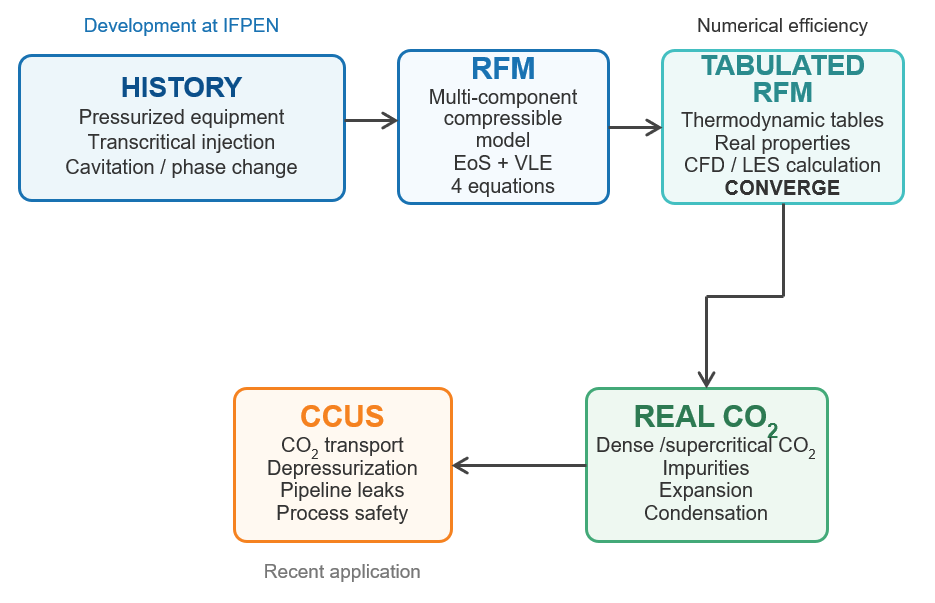
Conclusion and outlook
This research illustrates the evolution of the RFM, from a model designed for complex flows of real fluids at high pressure to a simulation methodology applicable to CCUS infrastructure. The combination of realistic thermodynamics, compressibility, phase changes, and the consideration of impurities provides a powerful tool for analyzing the transient phenomena encountered in CO2 transport and is useful when studying the design and safety of these infrastructures.
1 The state of a substance when its pressure or temperature exceeds that of the critical point (point on the temperature pressure diagram where the liquid gas equilibrum cruve ends). In the opposite case, it is in a subcritical state
2 Condition generated when a subcritical fluid is injected into a supercritical fluid.
3 At thermodynamic equilibrum, the Eo Sis a relationship between various physical parameters (pressure, volume, temperature) that determine its state.
4 Computational Fluid Dynamics
5 Method used in tubulence modeling
References:
[1] Songzhi Yang, Ping Yi, Chaouki Habchi, and Rafael Lugo. A multicomponent real-fluid fully compressible four-equation model for two-phase flow with phase change. Physics of Fluids, 31(3), 2019.
>> DOI : https://doi.org/10.1016/j.ijmultiphaseflow.2019.103145.
[2] Sajad Jafari, Hesham Gaballa, Chaouki Habchi, Jean-Charles De Hemptinne, and Pascal Mougin. Exploring the interaction between phase separation and turbulent fluid dynamics in multi-species supercritical jets using a tabulated real-fluid model. The Journal of Supercritical Fluids, 184 :105557, 2022.
>> DOI : https://doi.org/10.1016/j.supflu.2022.105557
[3] Hesham Gaballa, Chaouki Habchi, and Jean-Charles de Hemptinne. Modeling and LES of high-pressure liquid injection under evaporating and non-evaporating conditions by a real fluid model and surface density approach. International Journal of Multiphase Flow, 160 :104372, 2023.
>> DOI : https://10.1016/j.ijmultiphaseflow.2022.104372
[4] Harshit Bhatia and Chaouki Habchi. Real fluid modeling and simulation of the structures and dynamics of condensation in co2 flows shocked inside a de laval nozzle, considering the effects of impurities. Applied Sciences, 13(19) :10863, 2023.
>> DOI : https://doi.org/10.3390/app131910863
[5] Krishna Kant, Chaouki Habchi, Martha Hajiw-Riberaud, Al-Hassan Afailal, and Jean-Charles de Hemptinne. Study of supercritical co2 pipeline flow leaks: Effects of equation of state, impurity, and outlet diameter. Fluids, 11(4) :96, 2026.
>> DOI : https://doi.org/10.3390/fluids11040096
Scientific contacts: Chaouki Habchi, Jean-Charles de Hemptinne