



CIROQUO, the Research and Industry Consortium dedicated to the optimization and quantification of uncertainty for costly data (CIROQUO), was launched in 2021. The purpose of the consortium, bringing together academic and technological partners, is to solve problems related to the use of numerical simulators that deal with complex phenomena, with computation times that can extend over several hours or days. More specifically, the consortium aims to develop mathematical methods for dealing with issues such as the construction of numerical code substitution models involving complex data (functional or vector data, for example), error compensation in successive code calibration, and hybrid substitution model learning (taking physics into account). These tools are essential for conducting optimization, inversion, or calibration studies in the presence of uncertainties, while significantly reducing computation costs for the design of electric machines, wind turbines, and studies related to geological CO2 storage.
A thesis completed at IFPEN [3] is a good example of the type of research conducted within the CIROQUO consortium. Its aim was to propose a methodology for selecting variables for physical and numerical experimental designs dedicated to the calibration of models for expensive simulators. This thesis introduced a sequential method [4] that includes new criteria for selecting optimal physical and numerical experimental designs.
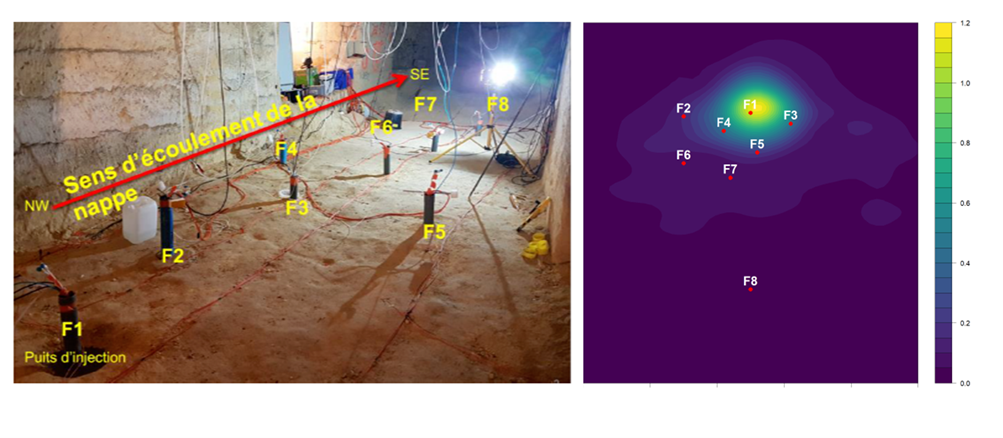
An optimization algorithm combining a heuristic method and a sequential approach was also proposed [3]. During the thesis research, the developments were applied to the calibration of a CO2 storage reservoir model, as illustrated in Figure 1. The proposed methodology was used retrospectively for the optimal placement of sensors for the calibration of a numerical model of a floating wind turbine.
Building on the experience gained from previous partnerships [1, 2], the consortium is supported by a collegial governance structure to define potential lines of research and allocate resources. This collaborative approach is backed up by biannual scientific conferences, promoting the sharing of advances in various areas of research, the emergence of new partnerships, and the identification of promising research avenues.
Overall, CIROQUO's work has already delivered advances in various aspects of numerical simulator analysis, opening up new applications and challenges - such as the robust optimization of expensive codes (with multiple versions) for electric machine design - which will be addressed over the duration of the consortium.
References:
[1] Christophette Blanchet-Scalliet, Céline Helbert, Delphine Sinoquet, Miguel Munoz Munoz Zuniga, Rodolphe Le Riche, et al.. Activity report ciroquo research & industry consortium. Ecole Centrale de Lyon; Mines Saint-Etienne; Université Toulouse 3 (Paul Sabatier); Stellantis France; BRGM (Bureau de recherches géologiques et minières); CEA; IFP Energies Nouvelles; Institut de Radioprotection et de Sûreté Nucléaire; Storengy; INRIA; CNRS. 2024, pp.1-11.
>> https://hal.science/hal-04661116v1
[2] Olivier Roustant, Rodolphe Le Riche, Josselin Garnier, David Ginsbourger, Yves Deville, et al.. Chair in applied mathematics OQUAIDO Activity report.[Research Report] Mines Saint-Etienne; Ecole Centrale Lyon; BRGM (Bureau de recherches géologiques et minières); CEA; IFP Energies Nouvelles; Institut de Radioprotection et de Sûreté Nucléaire; Safran Tech; Storengy; CNRS; Université Grenoble - Alpes; Université Nice - Sophia Antipolis; Université Toulouse 3 (Paul Sabatier). 2021. ⟨hal-03217277v2⟩
>> https://hal.science/hal-03217277v2
[3] Adama Barry. Plans d'expériences pour la calibration de codes de calculs coûteux. Applications [stat.AP] (Experimental design for the calibration of expensive codes. Applications). Université de Toulouse, 2025. Français. ⟨NNT : 2025TLSES068⟩.
>> https://theses.hal.science/tel-05186532
[4] A. Barry, F. Bachoc, S. Bouquet, M. Munoz Zuniga and C. Prieur (2024), Optimal Design of Physical and Numerical Experiments for Computer Code Calibration, submitted to IJUQ,
>> https://inria.hal.science/hal-04615127v2
Scientific contacts: Delphine Sinoquet, Miguel Munoz Zuniga