



Thesis by Pauline Bucciarelli : "Matériaux critiques pour la transition énergétique : entre sécurisation de l'offre et politiques de sobriété" (Critical materials for the energy transition: balancing supply security with sufficiency policies)
The energy and digital transitions require large quantities of critical metals and minerals. Although essential to the economy, these resources are exposed to significant supply risk. Indeed, their production and processing are concentrated in a small number of countries against a backdrop of increasing geopolitical tensions and global industrial demand. For Europe, which is heavily dependent on imports, ensuring a secure supply has therefore become a strategically important issue.
This research addressed the topic from three perspectives related to methodological, regulatory, , and societal developments:
- Criticality assessments, which aim to identify the most vulnerable resources, became widely used at the end of the 2000s as monitoring and decision-making tools. Using an econometric approach, the first stage of this study focused specifically on the empirical validity of the HHI1, one of the most commonly used indicators in these assessments [1]. The study concluded that relying on this indicator may lead to an underestimation of supply vulnerabilities for certain metals and in certain markets.
- More recently, the European Union has stepped up its response, with the introduction of the Critical Raw Materials Act (CRMA). The act sets objectives for developing Europe's extraction, refining, and recycling capacities and reducing reliance on a limited number of suppliers. Drawing on a model of the lithium value chain, a forward-looking approach based on various scenarios sought to assess the feasibility of the objectives set out in this regulation. The results suggest that the refining and recycling targets set by the CRMA remain very difficult to achieve under a baseline demand scenario, particularly due to the strong growth in European industrial demand [2].
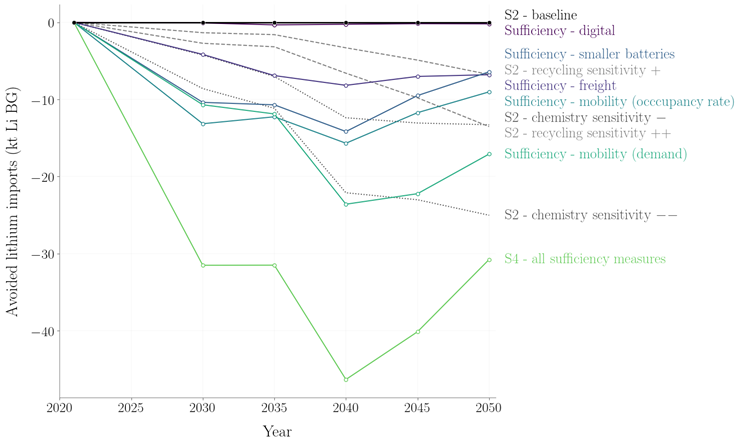
- If addressing the supply side is not enough, sufficiency policies, which are still largely absent from existing strategies and rarely incorporated into discussions on supply security, could play a role. The aim here would be to reduce resource needs through design and usage choices: for example, reducing the size of electric vehicle batteries, promoting carpooling, or decreasing the distances traveled. When incorporated into the scenarios studied, the analysis showed that these measures could reduce European demand for lithium by 46% between 2030 and 2050, and reduce reliance on imports by 44% (Figure 1). As a result, they would help make the the entire value chain more resilient [2].
These findings suggest that, for critical metals, sufficiency is not merely an option but a necessary complement to industrial and technological policies, and one that helps reconcile strategic autonomy with environmental objectives.
1 The Herfindahl–Hirschman Index (HHI) is expressed as the sum of the squares of the market shares of each producing country.
References:
[1] Bucciarelli, Pauline ; Hache, Emmanuel ; Mignon, Valérie (2025), "Evaluating criticality of strategic metals: Are the Herfindahl–Hirschman Index and usual concentration thresholds still relevant?", Energy Economics, 143, 108208.
>> DOI : https://doi.org/10.1016/j.eneco.2025.108208
[2] Bucciarelli, Pauline ; D’Herbemont, Vincent (2026). “The role of sufficiency in aligning European sovereignty and sustainability in the lithium value chain.” Ecological Economics, 251, 109182.
>> DOI : https://doi.org/10.1016/j.ecolecon.2026.109182
Scientific contact: Emmanuel Hache