



Over the past decade, the roll-out of offshore wind power has benefited from a significant reduction in equipment costs, driven by market growth and the scaling-up of production. However, additional margins would be possible through better control of operational uncertainties, making it possible to adopt a less conservative approach in design rules.
Over the past decade, the roll-out of offshore wind power has benefited from a significant reduction in equipment costs, driven by market growth and the scaling-up of production. However, additional margins would be possible through better control of operational uncertainties, making it possible to adopt a less conservative approach in design rules.
Given this potential, the European HIPERWIND project (in which IFPEN participated), aimed to gain a better understanding of the complex physics influencing the design and operation of large offshore wind farms with a view to enabling substantial cost savings for their owners and, ultimately, for electricity consumers.
More specifically, its objective was to quantify the various sources of uncertainty, including those relating to atmospheric conditions, in order to propagate them to the mechanical loading acting on the turbines and their foundations, and to integrate them into the economic assessment of facility design and maintenance.
In particular, uncertainties were quantified by comparing the results obtained from engineering tools, used by the industry, with so-called high-fidelity simulations1 [1], [2]. The propagation of these uncertainties, with consequences for design and maintenance, required new methods for calculating the probabilities of wind turbine component failures [4].
The project developed an efficient modeling chain for fatigue loading of the main components (blades, tower, and foundation), resulting from the wake effect2 in a wind farm [3], which is used in the offers of GreenWITS, IFPEN’s new subsidiary.
The HIPERWIND project has delivered a number of advances:
- on a phenomenological level: characterizing the effect of atmospheric stability on wake behavior, and the effect of wake superposition from different turbines when the wind direction is unfavorable in relation to their alignment [1];
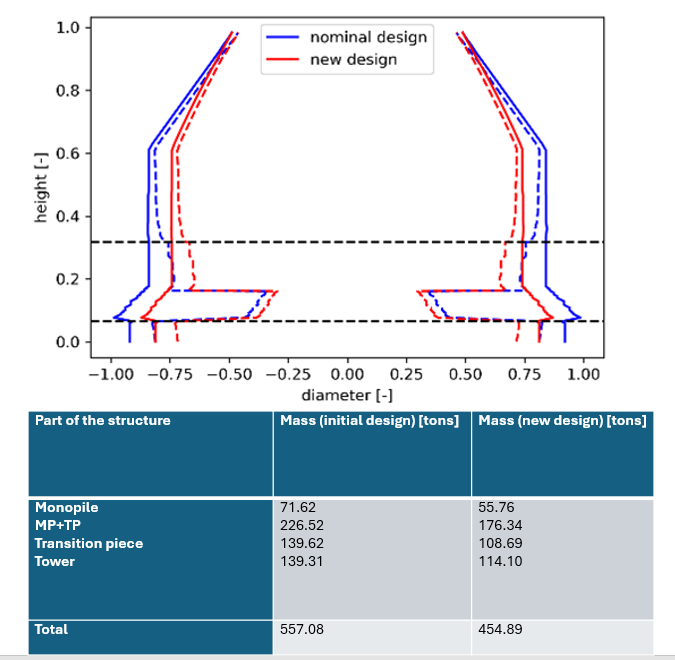
- in terms of design: optimization for a case study of a tower and its monopile foundation, leading to a 20% reduction of its mass (Figure 1) [4];
- in terms of economics: around a 10% reduction of the levelized cost of energy for a representative farm with 75 8MW turbines.
Within the framework of the HIPERWIND project, IFPEN has pooled its expertise with that of major research players. DTU, EDF, ETH Zürich, Bergen University, DNV and EPRI. This collaboration has been highly successful and lays the foundation for future research of interest in the field of wind energy.
1 With fewer simplifications of the modeled physical processes
2 Zone of reduced wind speed and additional turbulence downstream of a turbine

The HIPERWIND project was funded by the European Union’s Horizon 2020 Research and Innovation Programme under Grant Agreement No. 101006689 and has run for 3.5 years. All data and publications resulting from the project are publicly available on the project website.
References:
[1] Ardillon, E., Bakhoday Paskyabi, M., Cousin, A., Dimitrov, N., Dupoiron, M. Eldevik, S., Fekhari, E., Ferreira, C., Guiton, M., Jezequel, B., Joulin, P.-A., Lovera, A., Mayol, L. and Penchah, M.R., Turbine loading and wake model uncertainty, D3-2, European Union. 2023, pp.145. (2023),
>> https://ifp.hal.science/hal-04096504
[2] Peyrard, C., Robaux, F., Borràs Nadal, A. and Joulin, P.-A., Mayol, M.-L., Eldevik, S., Guiton, M., Cousin, A., Benoit, M.,Dimitrov, N. Lovera, A, Fereira, C., Aero-servo-hydroelastic model uncertainty, IFPEN; EDF; DTU; DNV. 2022, pp. Deliverable n° D3.3. (2022)
>> https://ifp.hal.science/hal-04033056
[3] Mc William, M., Bonfils, N., Dimitrov, N., Dou, S., (2022), Wind farm parameterization and turbulent wind box generation, DTU; IFPEN. 2022, pp. Deliverable n° D3.1
>> https://inria.hal.science/hal-04033050
[4] Cousin, A.,Munoz Zuniga, M., Franceschini, L., Guiton, M., Agrell, C., Dimitrov, N. K., Gramstad, O., Marelli, S., Mc William, M., Schär, S., Vanem, E., Wang, H., Winter, S., Kelly, M., Methods for efficient ULS reliability calculations and their impact on probabilistic design, IFPEN; DTU; DNV; ETH Zurich (Suisse), (2024),
>> https://ifp.hal.science/hal-04836508
Scientific contacts: Martin Guitton, Alexis Cousin, Pierre-Antoine Joulin