



A thesis supervised jointly with TU-Berlin
The flow of liquid films on complex surfaces is a configuration commonly found in chemical engineering equipment (in fixed catalytic beds, in structured packing columns for CO2 capture processes), but also in energy systems (for cooling electric motors or in evaporators). Understanding and modeling the behavior of these flowing liquid films is crucial to better analyze the phenomena at work and optimize the various systems involved.
Keen to launch a PhD project to expand and improve CFD1 models of liquid films based on the OpenFOAM opensource library, IFPEN asked TUB (Technische Universität Berlin) to come on board on a joint supervision basis2. The Process Dynamics and Operations Group, led by Prof. Jens Repke is renowned for its expertise in these areas and uses the same numerical simulation software. Collaboration on this thesis [1] therefore makes it possible to leverage the existing experimental databases of both partners and supplement them with new local mass transfer measurements.
On an experimental level, a new technique is currently being developed by Prof. Repke’s team. It combines local measurement of mass transfer, using planar laser-induced fluorescence (PLIF), with simultaneous measurement of local velocity, via µ-Stereo-PIV3. The method will enable more precise and complete data to be obtained for the validation of numerical simulations, particularly on real geometric configurations of structured packings.
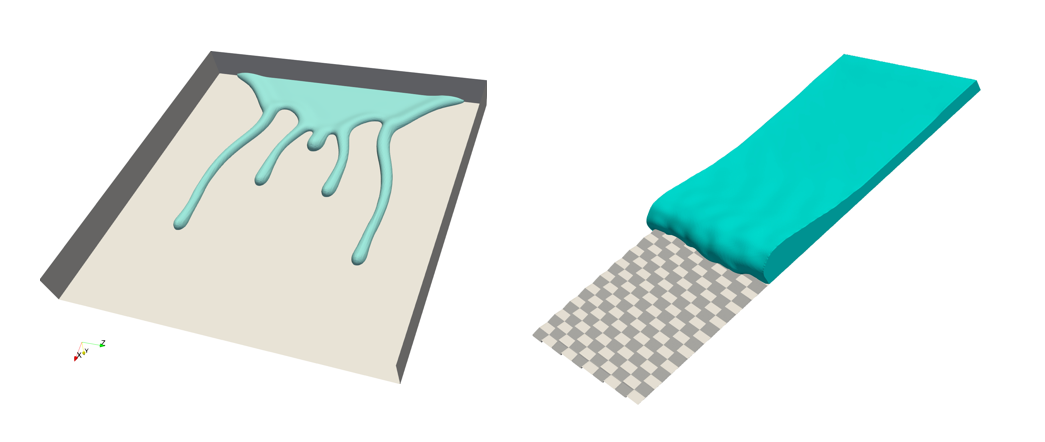
Fig. 1 shows two examples of simulations of flowing films, produced during this PhD research:
- On one side, a film forming rivulets on a flat vertical plate, reproducing the work of Lavalle et al. [2] ;
- On the other, a film flowing over a microstructure that was studied experimentally at TUB [3].
The ultimate objective of the thesis is to develop a digital twin capable of predicting, via Direct Numerical Simulation (DNS), both hydrodynamics and mass transfer in a representative small-scale volume,, with the objective to extrapolate these findings to a simplified larger-scale model. To this end, the research conducted for a previous IFPEN thesis [4], in which the geometric Volume-Of-Fluid (VOF) isoAdvector4 method was successfully extended to species transport and mass transfer, will be used.
1 Computational Fluid Dynamics
2 The doctoral researcher divides his time equally between Berlin and IFPEN's Lyon site. Prof. Jens Repke, for TUB, and Pascal Alix (IFPEN), for MEGA in Lyon, are joint supervisors of this thesis.
3 Allows measurement of the three components of velocity in the laser plane, using a second camera targeting the same area.
4 available in the OpenFOAM open-source library
References:
[1] T. Campos “ Modelization of falling liquid films over complex surfaces”, Thèse Université de Lyon - Technische Universität Berlin, 2024-2027.
[2] G. Lavalle, J. Sebilleau, and D. Legendre. “Rivulet cascade from falling liquid films with side contact lines”. Phys. Rev. Fluids, 5:124001, Dec 2020,
>> DOI : https://doi.org/10.1103/PhysRevFluids.5.124001
[3] S. J. Gerke and J.-U. Repke, “Experimental investigations of the fluid dynamics in liquid falling films over structured packing geometry” Chemical Engineering Research and Design, 2019,
>> DOI : https://doi.org/10.1016/j.cherd.2019.05.043
[4] Alexis Tourbier, Lionel Gamet, Philippe Béard, Typhène Michel, Joelle Aubin, Hrvoje Jasak, “A consistent methodology to transport a passive scalar with the geometric Volume-of-Fluid method isoAdvector”, Journal of Computational Physics, Volume 513, 2024
>> DOI : https://doi.org/10.1016/j.jcp.2024.113198
Scientific contact: Lionel Gamet