



Thesis by Mohammad Ameskal : "Pd-catalyzed butadiene alkoxycarbonylation: mechanistic insights and reaction improvement"
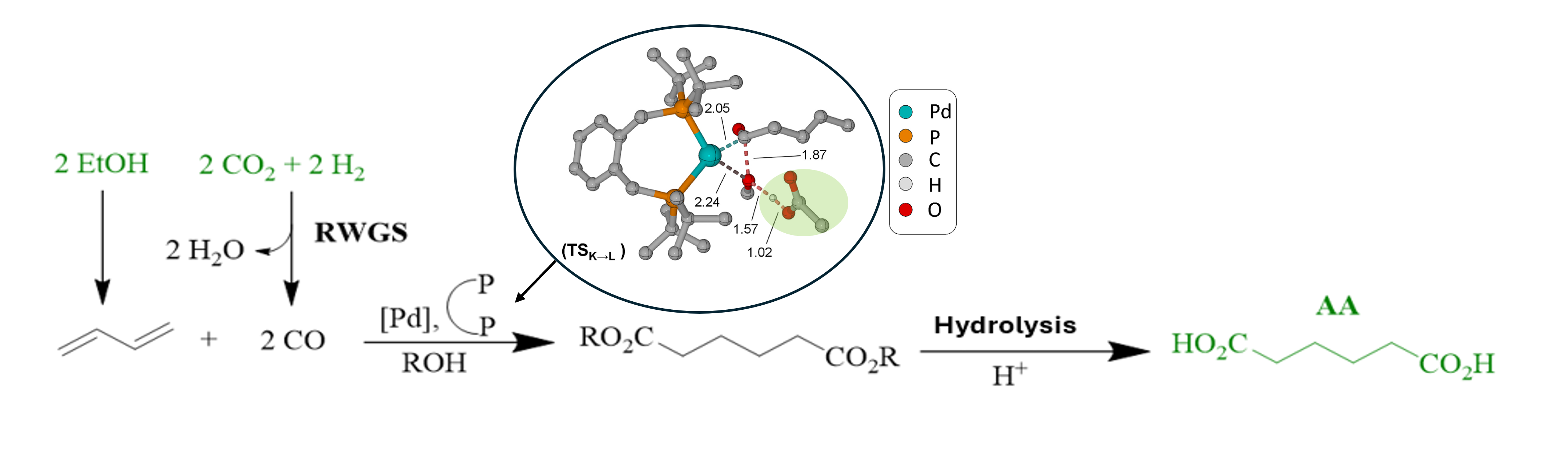
Adipic acid is a major industrial compound, primarily employed in the synthesis of Nylon 6-6, which is widely used in the textile industry. The current manufacturing process has a significant environmental impact due to the emission of large quantities of N2O, a powerful greenhouse gas. An alternative method, which is highly atom-efficient because it produces no reaction byproducts (Figure), is based on the direct synthesis of adipic acid esters via double alkoxycarbonylation of 1,3-butadiene using a palladium (Pd) catalyst. This reaction involves reacting a CO molecule (produced from CO2) and an alcohol with a butadiene molecule derived from bioethanol, making it sustainable. However, this reaction has limitations in terms of activity and selectivity that have yet to be fully elucidated.
This research has resulted in a greater understanding of the reaction mechanism through an approach combining kinetic studies, NMR1 spectroscopy, and DFT2 calculations, particularly by clarifying certain aspects of the catalytic cycle not previously taken into consideration:
• the formation of a key intermediate of the Pd(PI-allyl) type [1]
• the use of the acid-base pair (para-toluenesulfonic acid/acetate or trifluoroacetate) during proton exchange in the two stages of the alkoxycarbonylation process [1,2],
• the limiting nature of the isomerization step connecting the two alkoxycarbonylation steps [2].
These fundamental results inspired a more exploratory research approach, also addressed in the thesis, aimed at optimizing the catalytic system and reaction conditions. The approach was based on the addition of additives, such as ethers, that can influence the isomerization step, and on adjusting the concentration of the acid-base pair in the solvent.
Finally, with a view to progressing towards the industrialization of the process, a study on the use of ionic liquids paved the way for carrying out this reaction in a two-phase system (ionic liquid/organic solvent). The underlying idea is to facilitate recycling of the catalyst, which is contained in the ionic liquid, by improving its separation from the reaction products. Overall, this research led to the filing of three patents [3], which are a prerequisite for potential industrial application.
1 Nuclear Magnetic Resonance
2 Density Functional Theory
References:
[1] M. Ameskal, L. Magna, Juan M. Asensio, P. Raybaud, Mechanistic insights into the palladium-catalyzed alkoxycarbonylation of 1,3-butadiene, J. Catal. 2025, 450, 116235.
>> DOI : doi.org/10.1016/j.jcat.2025.116235
[2] M. Ameskal, L. Magna, Juan M. Asensio, P. Raybaud, Mechanistic and kinetic insights into the double alkoxycarbonylation of butadiene toward dimethyl adipate, J. Catal. 2026, 458, 116836.
>> DOI : doi.org/10.1016/j.jcat.2026.116836
[3] French filing Nº: 25/12.880, 25/12.881 et 25/04.869
Scientific contact: Juan Manuel Asencio Revert