



The increase in the number of electric vehicles requires the rapid and efficient deployment of EV charging stations (EVCS), since drivers are reluctant to “take the plunge” while the charging network is perceived as being inadequate. At the same time, operators are unwilling to invest without a guaranteed financial return. Yet the widespread adoption of electric vehicles, along with the need to balance energy supply and demand, requires that charging stations be strategically located, particularly along major highways.
The issue is further complicated by the highly interdependent nature of the factors involved: charging needs, route selection, and stations congestion. Consequently, charging demand has a direct impact on queueing times, which in turn alter routes and the distribution of traffic flows. Existing approaches rarely take this interaction into account in a coherent manner, thereby limiting their capacity to effectively determine the network’s requirements in terms of size and distribution of charging stations.
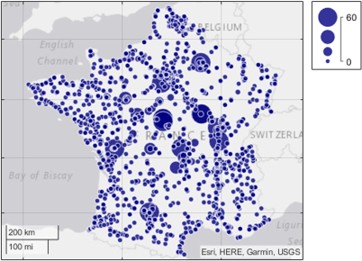
The method proposed by IFPEN [1] introduces a charging demand equilibrium model that makes it possible to estimate the spatial and temporal energy demand of electric vehicles, thereby eliminating the reliance on proprietary data from charging operators. This demand feeds into a queueing model (e.g., M/M/C)1, the parameters of which are derived from the overall mobility and charging needs across the study area. This tool makes it possible to estimate future queueing times (see example in Figure 1) and to inform decision makers about the optimal sizing and placement of charging infrastructure.
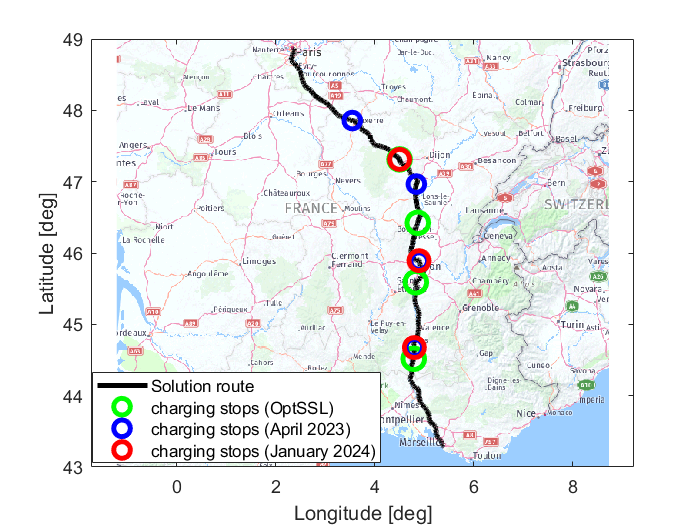
The results for an optimized network (as shown in Figure 2 and discussed in the caption) demonstrate not only greater network resilience in the face of increased demand but also an improvement in total journey time.
This approach provides a decision-making tool for EV charging station planners and operators by enabling them to identify bottlenecks, evaluate various scenarios for the development of electric mobility, and target investments toward the most critical areas.
Subsequent research will be aimed at enhancing the method’s operational effectiveness through the use of a dynamic equilibrium model and the provision of real-time monitoring of congestion at stations. The main scientific challenge now lies in the scale of the optimization problem and in the capacity to develop resolution methods that are sufficiently “scalable” to handle national networks and increasingly complex mobility scenarios.
1 In queueing theory, M/M/c is a multi-server queueing model. It describes a system in which arrivals form a single queue and behave according to a Poisson process, where there are c servers and the task processing times follow an exponential distribution.
Reference:
[1] I. Ben Gharbia and G. De Nunzio, "Location Planning of Fast Charging Infrastructure for Electric Vehicles and System Resilience Analysis via a Demand-Based Queueing Model", 2024 IEEE 27th International Conference on Intelligent Transportation Systems (ITSC), Edmonton, AB, Canada, 2024, pp. 1606-1613,
>> DOI : 10.1109/ITSC58415.2024.10919557
Contacts scientifiques : Ibtihel Ben Gharbia, Giovanni De Nunzio