



CIFRE thesis by Charles TANO (EDF, Mines ParisTech, IFPEN): “Hybrid optimization methodology for hydrogen valley design”
Low-carbon hydrogen production is an essential component of the various scenarios aimed at achieving carbon neutrality. However, there is still a gap between the large-scale roll-out trajectories envisaged by these scenarios and the industrial realities associated with the actual installation of infrastructure. This intermediate space, which remains largely unexplored in the scientific literature, is central to the research carried out in this thesis.
Low-carbon hydrogen production is an essential component of the various scenarios aimed at achieving carbon neutrality. However, there is still a gap between the large-scale roll-out trajectories envisaged by these scenarios and the industrial realities associated with the actual installation of infrastructure. This intermediate space, which remains largely unexplored in the scientific literature, is central to the research carried out in this thesis.
Focusing on the Dunkirk area, this research involved developing an innovative methodology for “soft” coupling between two complementary bottom-up1 optimization models: the MIRET-EU European energy system model (IFPEN) and the PHOENIX industrial site energy-material optimization model (EDF – Mines ParisTech). “Soft” coupling is based on an iterative process that ensures the convergence of results while preserving the consistency specific to each tool.
For MIRET-EU, coupling with PHOENIX makes it possible to more effectively take into account local regional constraints — such as land availability, access to water resources, or existing industrial capacities — as well as potential synergies between processes, which are likely to have a significant impact on decarbonization trajectories [1]. Reciprocally, this coupling gives PHOENIX a broader view of the region, placing it within the context of national and European dynamics: changes in demand for hydrogen and electricity, technological trade-offs, and interregional exchanges [2].
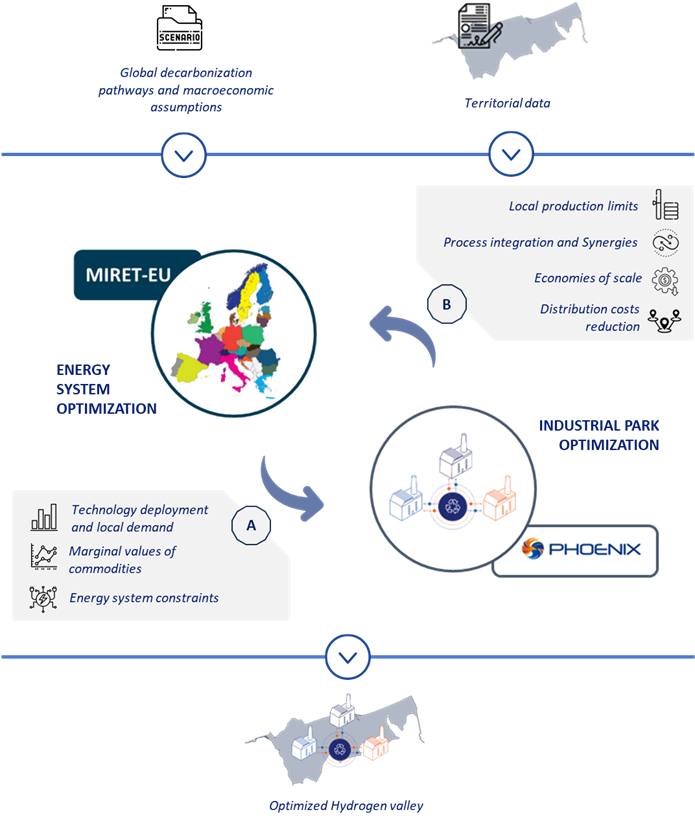
By combining the approaches of both models, the methodology developed makes it possible to integrate paradigms usually treated separately into a unified framework. It thus provides local decarbonization trajectories that are coherent with the overall optimization of the European energy system and compatible with the goal of net-zero emissions by 2050 (Figure 1). The results obtained identify specific decarbonization pathways by economic sub-sector, describe the long-term penetration dynamics of hydrogen and its derivatives, and establish realistic boundary conditions for local industrial clusters. Finally, they provide a solid basis for developing regional decarbonization strategies that are aligned with resource constraints and industrial synergy opportunities.
Beyond the results achieved, this thesis research illustrates the benefits of collaborative research, reinforced by the CIFRE mechanism, for which IFPEN's position at the interface between academia and industry enables effective synergies between the public and private sectors.
1 A bottom-up model is a modeling approach in which the overall behavior of a system is constructed from the explicit description of its individual components and their interactions. It specifies the underlying microeconomic, physical, or behavioral mechanisms and allows the aggregate dynamics of the system to emerge through composition or simulation.
References:
[1] Tano, N. C.; Malbec, L.-M.; Zoughaib, A.; Le Bourdiec, S. (2024). 37th International Conference on Efficiency, Cost, Optimization, Simulation and Environmental Impact of Energy Systems, ECOS 2024 (1), p. 60–71.
>> DOI : https://doi.org/10.52202/077185-0006
[2] Tano, N. C. ; Zoughaib, A. ; Le Bourdiec, S ; Malbec, L.-M. ; D’Herbemont, V. (2025) 43rd IEW, International Energy Workshop, Jun 2025, Nara, Japan.
Scientific contact: Louis-Marie MALBEC