


08.07.2026
3 minutes of reading


Estimating the residence time of plastics in marine environments is a major challenge for understanding their environmental fate, quantifying pollution fluxes, and improving oceanic transport models. Plastic aging has generally been assessed using a single physicochemical indicator, even though polymer degradation results from complex processes simultaneously driven by photo-oxidation, mechanical abrasion, biodegradation, the intrinsic properties of polymers, and environmental conditions.
An aging index based on several analysis techniques
In this context, Baby et al. (2026) proposed an innovative approach based on a multivariate aging index, referred to as the Aging Index (AI), derived from Principal Component Analysis (PCA). The objective was to combine multiple degradation indicators into a single metric to provide a more robust estimate of the exposure age of plastics in marine environments.
To develop this approach, several polymers - polyethylene (PE), polyethylene terephthalate (PET), and polylactic acid (PLA) - were subjected to aging in a seawater microcosm, reproducing controlled marine conditions for exposure periods ranging from a few months to ten years. Polymers were subsequently characterized using complementary analytical techniques, including Fourier-transform infrared spectroscopy (FTIR), Raman spectroscopy, elemental analysis coupled with isotope ratio mass spectrometry (EA-IRMS), and thermal Rock-Eval® analysis, which was used here for the first time as a tool for characterizing polymer aging.
A valuable tool for tracing plastic debris
The results showed that each analytical parameter evolved differently throughout the aging process. FTIR-derived indices revealed the formation of oxygen-containing functional groups associated with the oxidation of polyolefins, whereas crystallinity, carbon isotopic composition (δ¹³C), and Rock-Eval® parameters exhibited more complex, and sometimes non-linear, trends. These findings confirm that no single indicator can accurately capture the degradation level of marine plastics.
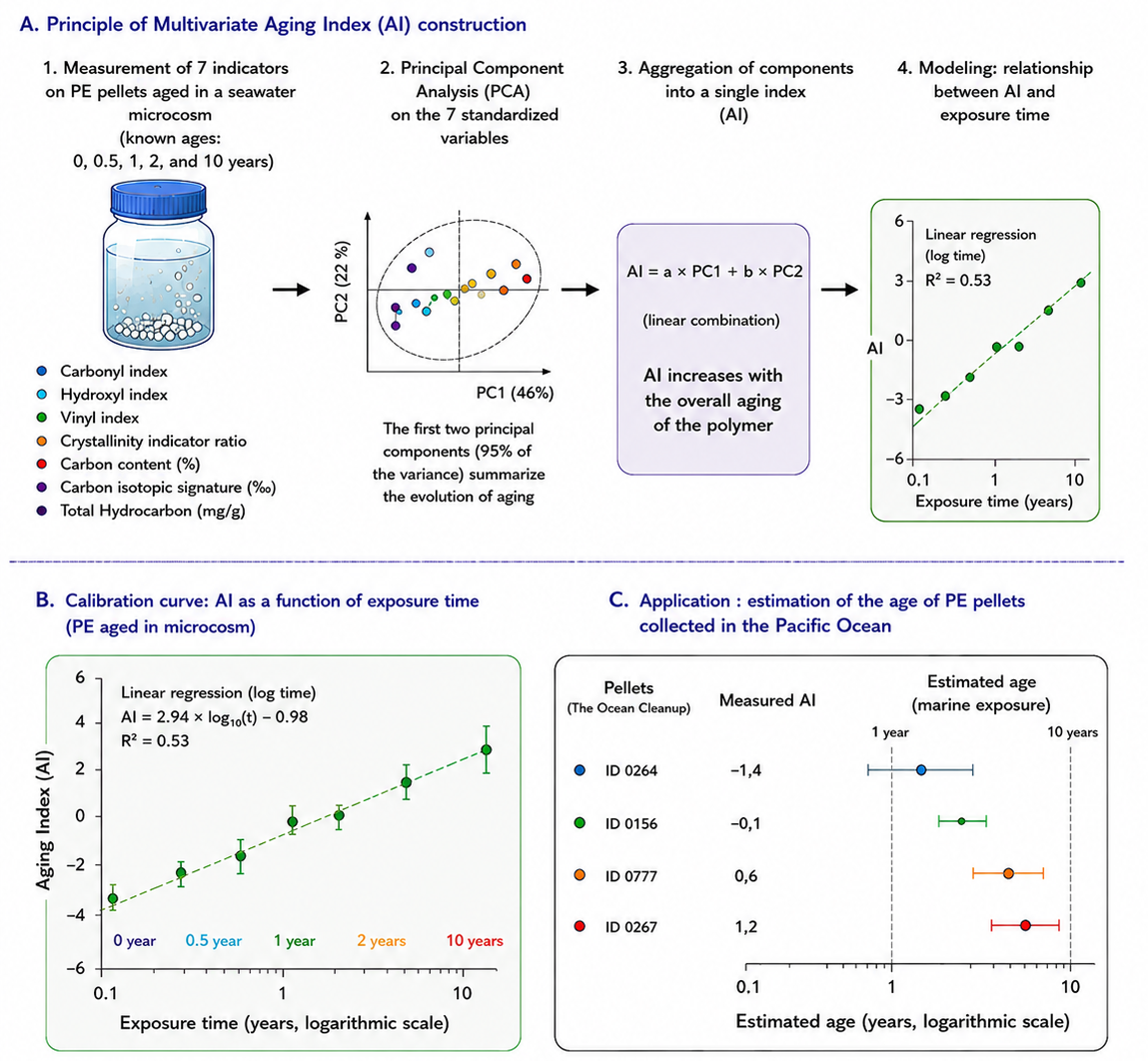
To overcome this limitation, seven analytical parameters, measured on polyethylene pellets aged in the seawater microcosm, were selected. The principal components obtained from PCA, accounting for 95% of the total variance, were then combined into a single descriptor, the Aging Index (AI). A regression model relating the AI to exposure time was subsequently established, allowing the degradation age of environmental plastic samples to be estimated.
The model was then applied to four polyethylene pellets collected from the Pacific Ocean by The Ocean Cleanup®, resulting in estimated marine exposure durations ranging from 1 to 2.5 years.
The overall methodological framework, including method development, calibration, and validation, is summarized in Figure 1.
This study represents a significant methodological advance by introducing a multivariate approach that more effectively captures the complexity of plastic aging than conventional single-parameter indicators. In the long term, the Aging Index could become a valuable tool for tracing plastic debris, reconstructing pollution scenarios, and validating models of microplastic transport in marine environments.
Reference:
Baby, M.G., Romero-Sarmiento, MF., Rohais, S. et al. A multivariate approach to estimate the degradation age of plastics in marine environments. npj | Material Degradation (2026).
>> DOI: https://doi.org/10.1038/s41529-026-00825-5
>> Cite as: https://www.nature.com/articles/s41529-026-00825-5#citeas
Scientific contacts: Maria-Fermanda Romero-Sarmiento, Sébastien Rohais
You may also be interested in

Publications - la méthode Rock-Eval® pour la caractérisation des plastiques
1. Baby, MG., Gerritse, J., Beltran-Sanahuja, A., Wolter, H., Rohais, S., Romero-Sarmiento, M.-F. (2024).

Polymer quantification using the Rock-Eval® device: a methodology for the identification of plastics in sediments
