


09.09.2026
3 minutes of reading


The development of electric vehicles has been accompanied by technological advances resulting in more compact and higher-speed motors (rpm), which create significant heat fluxes within reduced volumes. This leads to the emergence of critical zones in terms of material integrity. Direct cooling by oil jets applied to localized regions appears to be a promising solution to this issue, but remains challenging to simulate numerically. Indeed, the resulting flows are characterized by high Prandtl numbers (Pr)1 and, consequently, a very thin thermal boundary layer2, particularly in the jet impingement zone, where cooling is most effective. As a result, in Computational Fluid Dynamics (CFD3), explicitly resolving this boundary layer in large-scale geometries requires very fine meshes and often prohibitive computation costs.
For this reason, in order to avoid explicit resolution of the thermal boundary layer, a near-wall thermal model, specifically designed for high-Prandtl number fluids and laminar flows, was developed as part of Adrien Ingles’ PhD thesis [1,2]. The model, implemented in the Converge CFD code, is based on Lévêque’s analytical solution [3] and makes it possible to estimate the wall heat flux from the local temperature, without requiring the solution of additional equations. This approach is illustrated in Figure 1 for a liquid jet impinging on a flat surface, where the Prandtl number can reach values as high as 1,000.
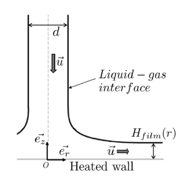
Figure 2 shows the radial distribution of the Nusselt number 𝑁𝑢, characterizing local heat transfer between the wall and the fluid. It compares a case in which the thermal boundary layer is fully resolved using a very fine mesh (reference solution denoted by Ar) ) to simulations performed on a coarse mesh, with and without the developed model (Acm and Ac respectively). On the under resolved mesh (less than one cell across the thermal boundary layer), the absence of the model leads to a significant under estimation of 𝑁𝑢, with an error as high as 40% in the impingement zone, where the thermal layer is thinnest (Ac case). Applying the model (Acmcase ) significantly reduces this underestimation; the radial profile of 𝑁𝑢 obtained with the coarse mesh and our model closely approximates the reference solution (Ar case).
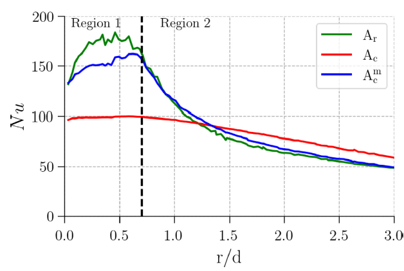
Moreover, using the model significantly reduces the computational cost compared to a fully resolved case: for the configuration tested at Pr=158, the reduction in computational time is around 68%, and can reach 93% for Pr ≈ 1000. Thus, the proposed method offers an excellent compromise between accuracy and computational cost, making it particularly well-suited for parametric studies and the preliminary design of oil-jet cooling systems for electric motors.
In conclusion, the newly developed model provides an effective solution for estimating wall heat transfer in high-Pr laminar liquid jets, while avoiding the extreme mesh refinement required to fully resolve the thermal boundary layer. Ongoing work aims to extend its validity to more complex flow configurations that no longer satisfy Lévêque’s hypotheses.
1 A dimensionless number (ratio of thermal diffusivity to kinematic viscosity) that compares the rates of thermal and hydrodynamic phenomena in a fluid
2 A region of fluid in contact with a solid surface where the temperature varies significantly due to heat transfer
3 Computational Fluid Dynamics
References:
[1] Ingles A. Un modèle proche‑paroi pour la prédiction des transferts thermiques dans les écoulements laminaires à haut nombre de Prandtl : application aux jets liquides impactants pour le refroidissement des moteurs électriques électriques [A near-wall model for predicting heat transfer in high Prandtl number laminar flows: application to impacting liquid jets for cooling electric motors]. Thèse de doctorat de l’université de Montpellier, 2026.
[2] Ingles A., Poubeau A., Vinay G., Nicoud F. A near-wall model for heat transfer prediction in laminar flows at high Prandtl number. Computers and Fluids 315 (2026),
>> DOI : https://doi.org/10.1016/j.compfluid.2026.107137
[3] Lévêque A. Les lois de la transmission de chaleur par convection [The laws of heat transfer by convection] Ann des Mines 13 (1928)
Scientific contacts : Adèle Poubeau, Guillaume Vinay
You may also be interested in
Electric motor: oil cooling is more difficult
The thermal management of electric motors is an essential element in competitive low-carbon mobility, since more efficient cooling not only increases motor performance density (power or torque by mass), but also improves operational reliability by preventing deterioration phenomena (such as demagnetization)...