


17.02.2026
3 minutes of reading



The OWWAAW (Offshore wind farms: effects on weather, acoustics and aerial wildlife) project was launched on January 26, 2026. The project will study the interactions between offshore wind farms and weather, as well as their effects on output, acoustics, and aerial biodiversity (birds and bats). The aim is to optimize resource estimation while reducing environmental impacts, in order to improve the social acceptability of wind energy.
This project will be conducted from 2026 to 2029 by a research consortium comprising IFPEN, as project coordinator, and three other partners: Météo France (the French national weather service), the Environmental Acoustics Joint Research Unit* and the French Natural History Museum. The OWWAAW project is also supported by ADEME and OFB (French Biodiversity Office), and certified by the Mer Méditerranée and Mer Bretagne Altlantique competitiveness clusters.
Complex phenomena
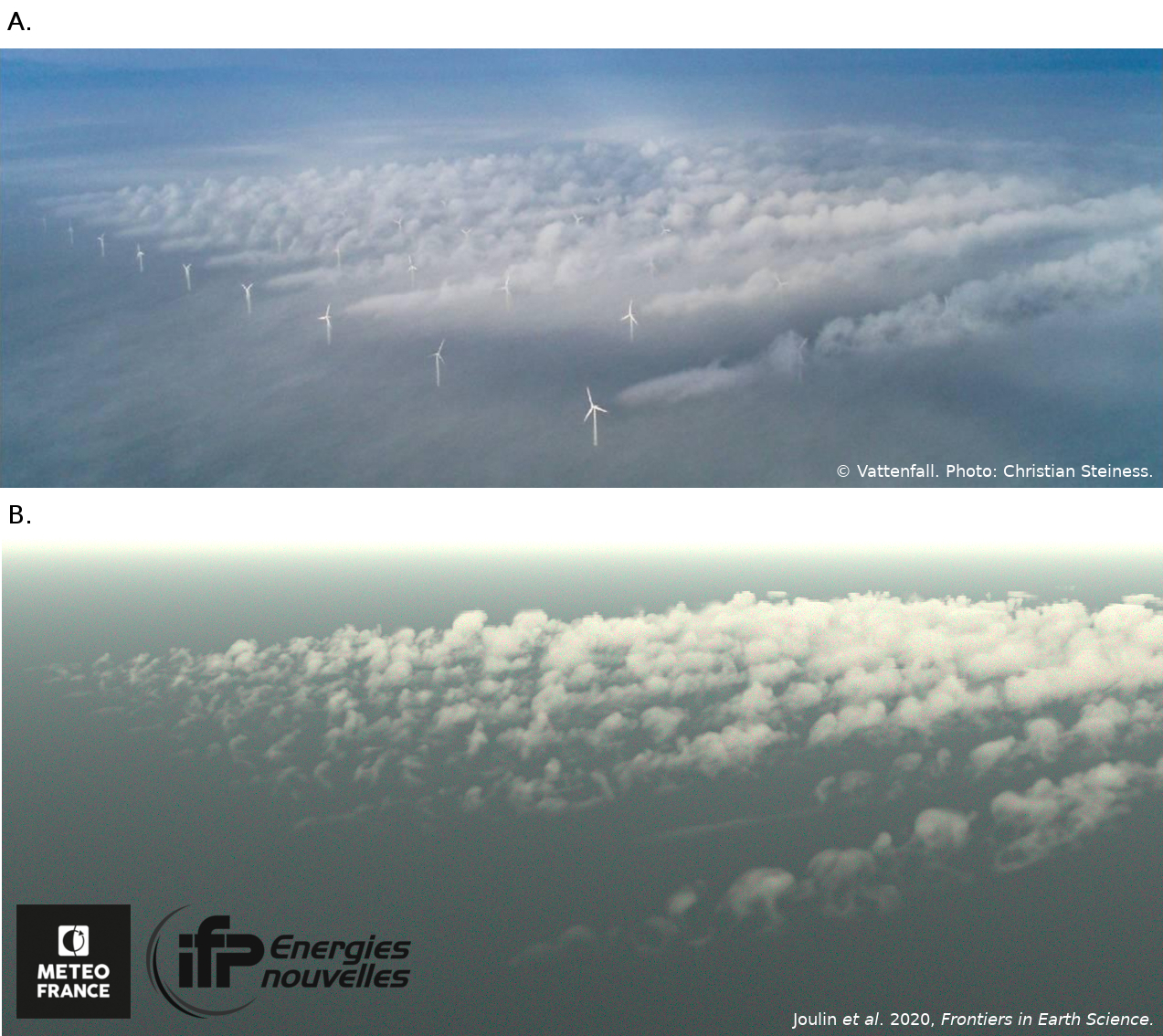
France has big ambitions when it comes to renewable energy, but the impact of wind turbines on weather-related phenomena (and consequential effects on the efficiency of wind farms), noise pollution, and biodiversity (particularly birds and bats) is still poorly understood. While interactions between wind turbines and the atmosphere are beginning to be taken into account in models, researchers have not yet fully understood the influence of these interactions on cloud formation and rainfall, or on acoustic emissions and propagation, particularly low-frequency waves that can reach the coast. The combined effects of weather changes and noise could also disrupt the behavior of birds and bats, raising many concerns.
A multidisciplinary project
To address this lack of knowledge, the OWWAAW project was set up by four highly complementary research teams, who will pool their expertise to try to answer these questions: aerodynamicists, meteorologists, acoustics engineers, and ecologists.
This project comprises several components.
One aspect of the project focuses on the interaction at sea between the lower layer of the atmosphere (atmospheric boundary layer) and wind turbines, using advanced numerical modeling that combines the expertise of Météo-France's National Meteorological Research Center on atmospheric phenomena and that of IFPEN on aerodynamic mechanisms specific to wind power”, explains Pierre-Antoine Joulin (IFPEN), who heads up the entire project. “The work will also involve a large-scale experimental campaign conducted around the St Nazaire offshore wind farm, including meteorological, acoustic, and telemetric measurements of birds, in order to better understand the interactions between wind turbines and their natural environment. This data will serve to validate numerical models, which will then be used to simulate specific scenarios for subsequent in-depth analyses.”
Thanks to a better understanding of the impacts of wind turbines on weather, acoustics, and biodiversity, the OWWAAW project will enable recommendations to be made to improve the efficiency of wind farms, and reduce their environmental impact. It will help make wind farm projects more acceptable by meeting society's expectations regarding the impact on birdlife.
A framework research agreement between Météo France and IFPEN
The OWWAAW project is part of a broader collaboration between Météo France and IFPEN, recently formalized in a framework agreement (link) between the two organizations. In particular, this collaboration led to the involvement of Météo France experts in the Offshore Wind Project Development specialized engineering program at IFP School, and also to theses jointly supervised by the two organizations.
*The Joint Research Unit in Environmental Acoustics (UMRAE) is a joint research laboratory between Gustave Eiffel University and the Centre for Studies and Expertise on Risks, Environment, Mobility and Planning (CEREMA).
You may also be interested in
A new numerical tool to simulate the interaction between wind farms and local meteorological conditions
The French long-term energy program is encouraging the growth of wind energy. In order to predict this energy production and attempt to optimize it, irrespective of the production site (sea, mountain), a better understanding of wind flow...