



The performance of a catalyst support — whether alumina or zeolite — depends on the properties of its porous microstructure: porosity, specific surface area, and the connectivity of the solid network, which govern the access of reactants to active sites. Designing an optimal support thus amounts to solving an inverse problem, i.e., identifying the microstructure, and then the manufacturing parameters, that satisfy a set of property specifications.
However, the problem here is compounded by the fact that several very different microstructures can exhibit the same macroscopic properties, and that traditional optimization methods - which are costly in terms of computation - will explore only a fraction of them.
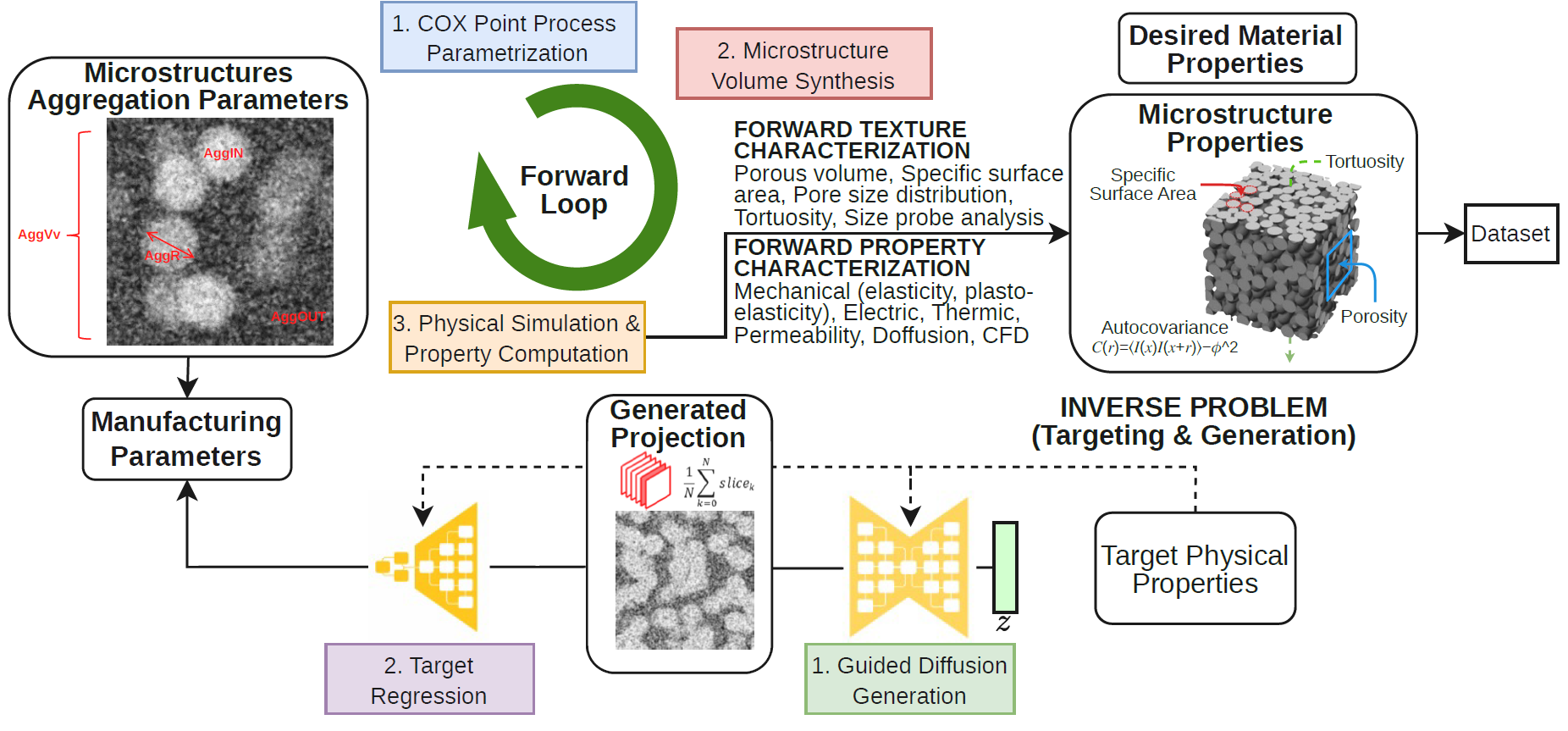
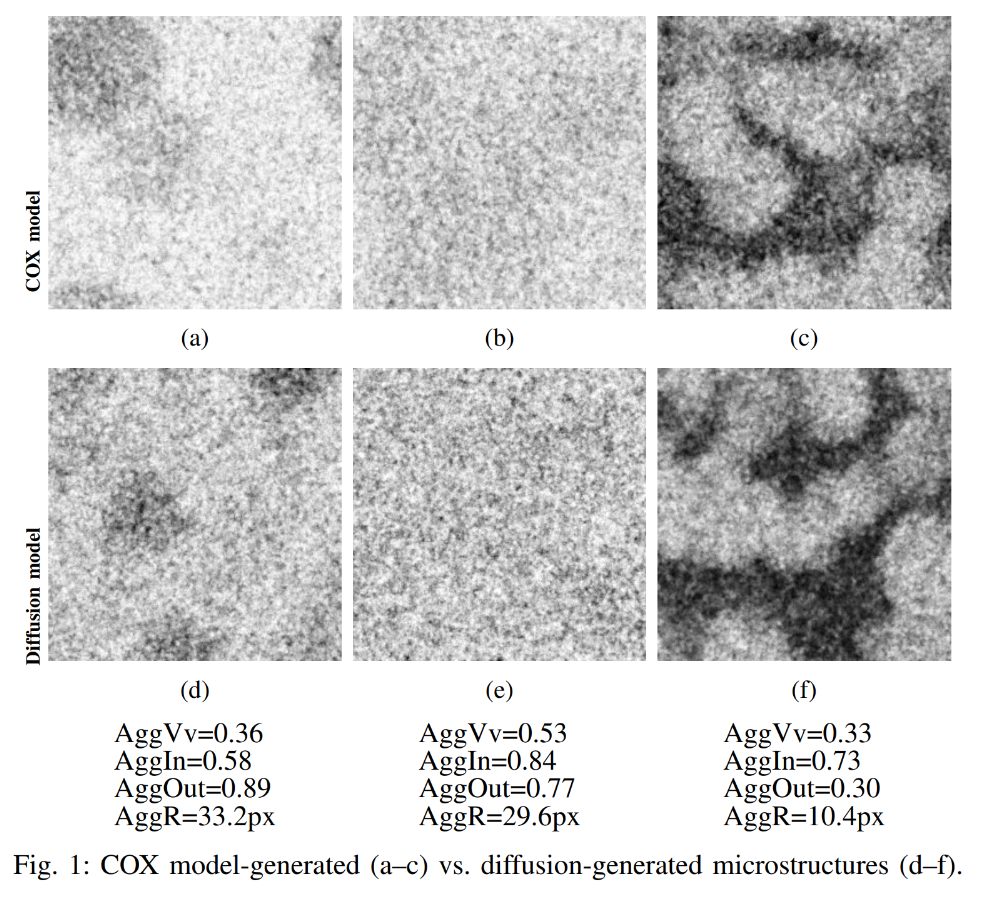
Typically, a geometric model starts with manufacturing parameters to simulate a microstructure, and then calculates the resulting properties: this is the forward loop. To solve the reverse problem – tracing back from target properties to a microstructure, and then to its manufacturing parameters – researchers at IFPEN supplemented this forward loop with a reverse loop [1], based on a guided diffusion model, the type of AI used in image generators (Figure 1). Trained on 30,000 virtual microstructures derived from a random geometric model (COX1 process), the neural network gradually “denoises” an image of random noise until it obtains a microstructure that conforms to the target properties. The target properties guide the neural network at each step, acting like a filter that directs the transformation of noise into a microstructure (Figure 2).
Since the starting point is chosen at random each time the calculation is run, each use of the trained model produces a different but valid microstructure, since it possesses the same target properties, reflecting our physical reality.
Once a satisfactory microstructure has been established, a second convolutional neural network2 (dedicated to image analysis) then derives the four aggregation parameters of the geometric model, which are directly linked to the manufacturing parameters.
Based on nearly 3,000 test microstructures, these parameters were identified with an average coefficient of determination (R²) of 0.85 (where a value of 1 corresponds to a perfect prediction). The “round-trip” validation4 confirms the physical consistency of the properties obtained, all thanks to a calculation that takes just a few seconds, compared to several hours using traditional methods.
Subsequent research steps will focus on the 3D generation of microstructures, the inclusion of additional mass transport descriptors (tortuosity, physisorption), and validation using real materials characterized experimentally.
1 A probabilistic microstructure generation method that can be used to simulate polycrystalline grain assemblies in 2D or 3D, based on randomly placed nuclei that then grow in regular circles to define the grain boundaries
2 Deep learning architecture specialized in processing structured data in matrix form
3 A stochastic model driven by four parameters: AggVv (aggregate volume fraction), AggIn (intra-aggregate fraction), AggOut (extra-aggregate fraction), AggR (average aggregate radius)
4 Resynthesis of a microstructure from predicted parameters
Reference:
[1] J. Peyrelon, A. Pirayre, L. Sorbier, M. Moreaud, A. Hammoumi, Guided Diffusion Model for Microstructure Generation Design, conference paper, 2026 (DOI pending).
Scientific contact: Julien Peyrelon