



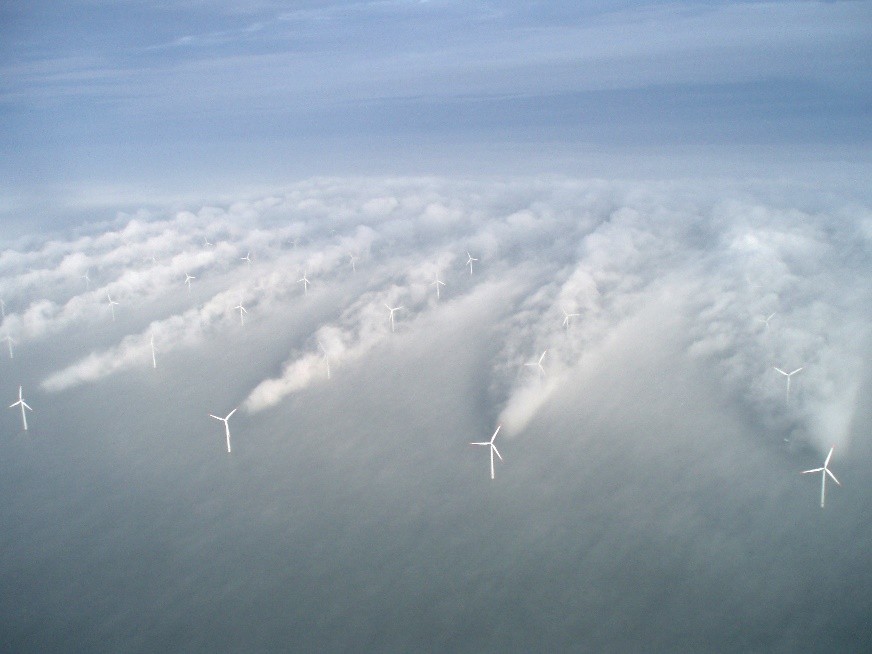
To maximize energy production and streamline operations, operators are designing wind farms that incorporate an increasing number of turbines. However, under certain wind conditions, wind turbines frequently interact through what is known as the wake effect. The wake is created behind the rotor as it intercepts the wind's kinetic energy to convert it into electricity. Due to the conservation of energy, a zone of low wind speed develops, accompanied by increased turbulence. Each wake, the length of which is tens of times the diameter of the rotor that generates it, can then disrupt the operation of other wind turbines located downstream, as shown in Figure 1, where exceptional atmospheric conditions made it possible to observe the phenomenon. These wakes result in significant production losses as well as increased mechanical stress.
To minimize these effects as much as possible, IFPEN is working on several methods:
- The first approach, applied from the outset of the design phase, involves taking into account all expected wind conditions over the wind farm’s lifetime in order to select the locations of the wind turbines in a way that minimizes their mutual interference [1].
- The second approach, applied during operation, involves independently controlling each wind turbine based on wind conditions. To do so, it is possible to redirect the wake by adjusting the yaw angle of the nacelle, as shown in Figure 2.
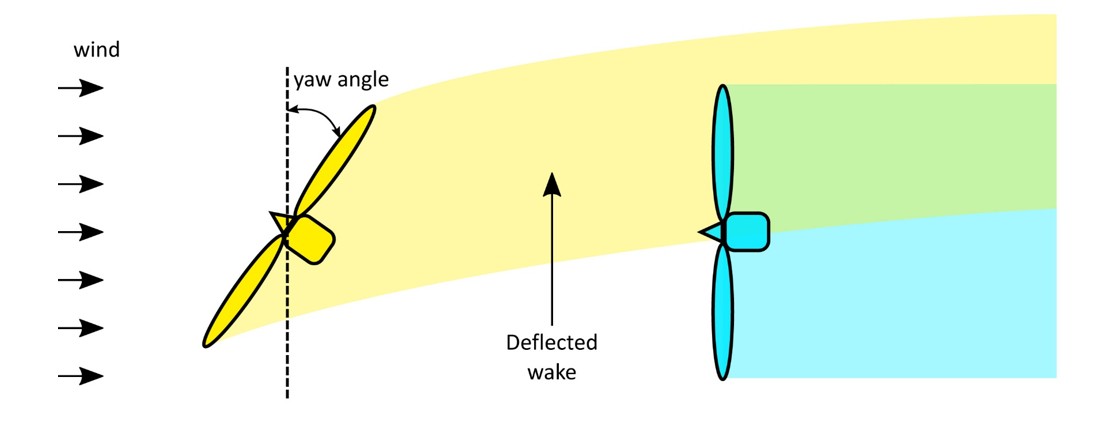
Changing the yaw angle (which is initially zero so that the wind turbine faces the wind) will result in a decrease in production from that particular wind turbine. Therefore, there is an optimal range of angles to be determined that reduces the power output of some wind turbines while increasing that of others, resulting in maximized overall power output (Figure 3).
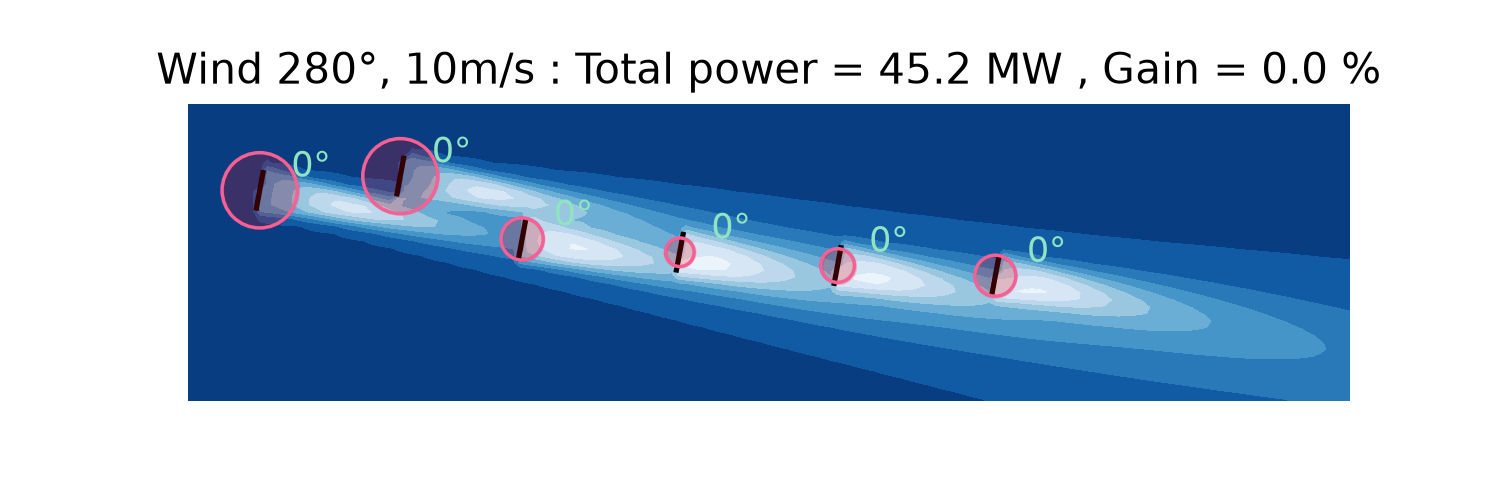 | a. Standard operation of a wind farm: each wind turbine is controlled individually to face the prevailing wind.
|
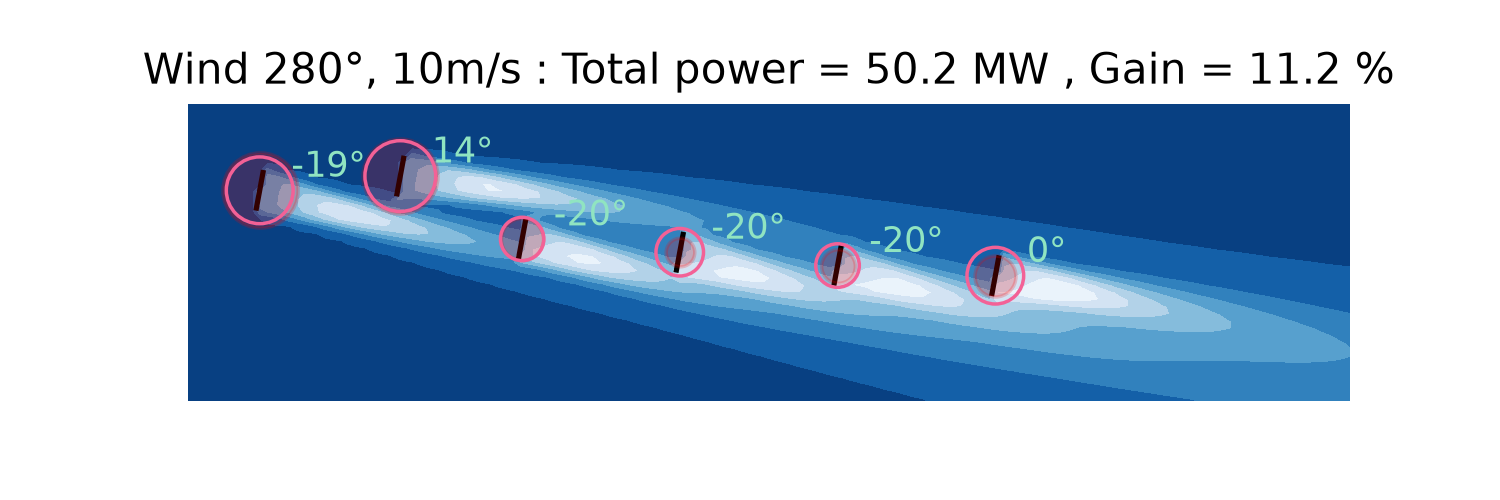 | b. Coordinated control of the wind farm: production is optimized by purposefully misaligning the wind turbines with respect to wind direction. |
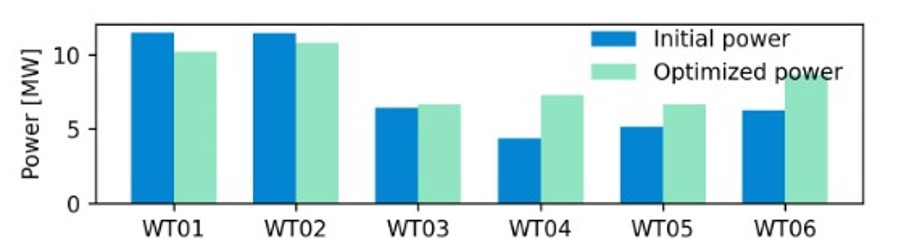 | c. Power generated by each turbine before and after applying wake steering. |
Figure 3: Wake steering increases the total output of a wind farm (the size of the red circle is proportional to the turbine's output).
Calculating these angles is no easy feat, as aerodynamic phenomena are notoriously difficult to model. In addition, optimizing electricity production in real time requires models that are both reliable and fast in terms of computation time. Such models are implemented in the FarmShadow software suite, developed by IFPEN, to predict wind farm output based on given wind conditions and yaw angles. Intensive use of these models and the “cost function” created with FarmShadow makes it possible to determine the yaw angles that maximize overall electricity production while ensuring that the mechanical stress on the wind turbines remains at an acceptable level in terms of their operational lifespan [2]. In addition, estimation algorithms make it possible to evaluate certain parameters based on observations made by sensors located throughout the farm [3,4] and thus to adapt the model.
All of these numerical model-based monitoring and estimation solutions were developed as part of the CAP project (Contrôle Avancé de Parc or Advanced Farm Monitoring), funded by ADEME1.
They complement other methods, based solely on data (i.e., they involve no prior modeling), already presented in a previous article and for which reinforcement learning algorithms were used to maximize the farm output [5].
Finally, IFPEN is actively contributing to other research projects that take into account these wake effects in order to better integrate wind power into the power grid [6] and to help ensure its stability. Adjusting the total power output of a wind farm, as required by grid operators, can be achieved using algorithms designed to determine how to distribute this total power among the various turbines in a way that optimizes certain criteria, such as mechanical resistance.
The CAP project also aims to implement and test these control solutions in real operating conditions.
1 Within the framework of the France 2030 investment plan
References :
[1] Malisani, P., Bartement, T., & Bozonnet, P. (2025). Offshore wind farm layout optimization with alignment constraints. Wind Energy Science, 10(8), 1611-1623.
[2] Gharbia, I. B, et al. (2026). Wake steering optimization under multiple cumulative fatigue load constraints. In Journal of Physics: Conference Series (Vol. 3224, No. 3, p. 032086). IOP Publishing.
[3] Dubuc, D., & Tona, P. (2025). LiDAR-assisted closed-loop control of a wind farm. In Journal of Physics: Conference Series (Vol. 3016, No. 1, p. 012023). IOP Publishing.
[4] Collet, D., & Tona, P. (2025). Design and evaluation of EnKF-based estimators for steady-state-model-based wind farm control. In 2025 American Control Conference (ACC) (pp. 2862-2869). IEEE.
[5] Monroc, C. B. (2024). Multi-agent reinforcement learning for dynamic wind farm control (Doctoral dissertation, Ecole normale supérieure-PSL).
[6] Corban, B., Bušić, A., Dubuc, D., & Zhu, J. (2026, May). Wind farm power tracking using reinforcement learning for secondary frequency regulation. In Journal of Physics: Conference Series (Vol. 3224, No. 3, p. 032088). IOP Publishing.
Scientific contacts: Paolino Tona, Donatien Dubuc