



Thesis by Helen Schottenhamml : "Lattice Boltzmann Methods for Large-scale Wind Energy Applications: Wind Turbine Modelling in an Atmospheric Boundary Layer"
Understanding flows within and around wind farms, and how they interact with local weather conditions, is essential for improving their modeling and developing tools tailored to the needs of designers and operators. However, the multiple spatial and temporal scales involved and the complexity of conducting measurements on site or in a wind tunnel are a real challenge. Large-eddy simulation (LES) makes it possible to overcome these limitations, but the high resolution of these calculations, based on Navier-Stokes equations, remains too costly, in terms of both time and energy [1], for intensive use, such as deriving and calibrating analytical models, for example.
The alternative that was studied is the Lattice Boltzmann Method (LBM), which significantly reduces simulation costs through largely local computations that are highly parallelizable, as well as through the use of mixed-precision strategies1 The research focused on adapting and optimizing sub-grid, boundary condition, and rough wall models2 to the LBM framework. A comprehensive solver, waLBerla-wind [2, 3], was produced and high-resolution databases were created, thereby enabling the development of a turbine wake turbulence model.
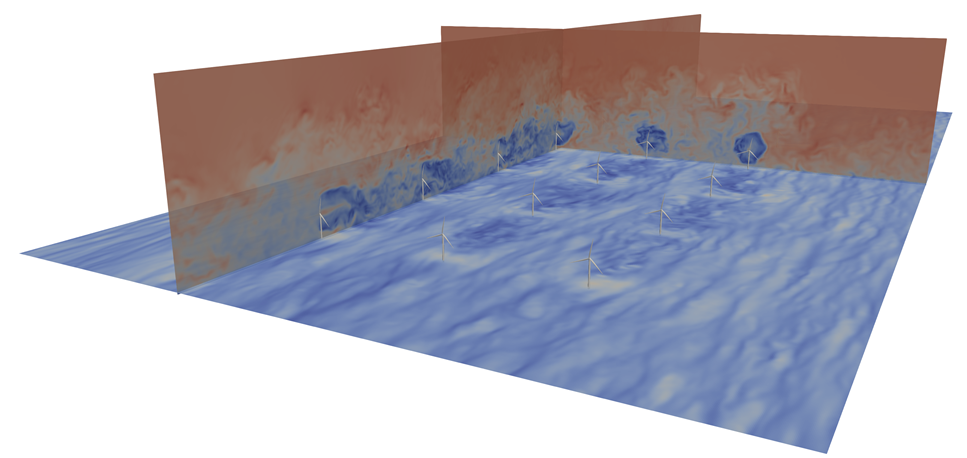
GPU3 implementation of the LBM method makes it possible to very quickly simulate entire wind farms subject to atmospheric boundary layers and the interactions between those layers and the turbines (Figure 1). By incorporating user requirements regarding functionality and post-processing, waLBerla-wind is a tool well-suited for use by research engineers. For example, online algorithms for calculating the averages of double correlations (Reynolds tensor) or triple correlations (turbulent transport) were developed [4] to enable a detailed analysis of the underlying physics.
The tool is currently being extended to more complex atmospheric conditions, particularly those related to the effects of topography and heat flows.
1 Use of variable and adapted levels of precision, in terms of the scalars used in the calculations
2 A surface on which friction forces vary in strength depending on its roughness
3 The use of Graphics Processing Units to speed up calculations
References:
[1] Schottenhamml H, Anciaux-Sedrakian A, Blondel F, Borras-Nadal A., Joulin P-A, Rüde U, "Evaluation of a lattice Boltzmann-based wind-turbine actuator line model against a Navier-Stokes approach", Journal of Physics: Conference Series, 2022
>> DOI : 10.1088/1742-6596/2265/2/022027
[2] Boella E. ,… Schottenhamml H., &… Anciaux-Sedrakian A., … (2026). "The Energy-Oriented Centre of Excellence: Invited Paper". 163-17, 20261
>> DOI : 10.1145/3801488.3806243
[3] Schottenhamml H., Anciaux-Sedrakian A., Blondel F., Köstler H., Rüde U., "waLBerla-wind: A lattice-Boltzmann-based high-performance flow solver for wind energy applications", Concurrency and Computation: Practice and Experience, 2024
>> DOI : 10.1002/cpe.8117
[4] Blondel F., Jézéquel E., Schottenhamml H. & Bastankhah M., "Analytical modelling of wind-turbine wake turbulence in neutral atmospheric boundary layers", Journal of Fluid Mechanics, 2026
>> DOI : 10.1017/jfm.2026.11685
Scientific contacts: Helen Schottenhamml, Frédéric Blondel, Ani Anciaux-Sedrakian