



The SPE11 benchmark study, conducted under the auspices of the Society of Petroleum Engineers (SPE), brought together teams of researchers from universities, research organizations, and companies specializing in geological CO₂ storage [1]. The purpose of the project was to compare the performance of numerical simulators designed for this particular application. Based on test cases with common input data and evaluation criteria, the study analyzed the ability of calculation codes to reproduce the main physical processes at play in the injection and migration of CO₂ in geological reservoirs. The primary goal of the initiative was to build confidence in the simulators used to design and evaluate storage projects by assessing the discrepancies between the results obtained.
For the codes included in the benchmark, the main challenges lie as much in the physics, with the simulation of multiphase flows in highly heterogeneous media and the coupling of multiple phenomena (capillarity, gravity, CO₂ dissolution, etc.), as in the numerical field, with challenges related to the stability of computational schemes, the convergence of solvers, and the representation of phase interfaces.
Figure 1 shows, firstly, the heterogeneities of the reservoir under study as well as the locations of the two CO₂ injection wells and, secondly, the final distribution of CO₂ dissolved in water, revealing the presence of gravity-induced finger-like structures associated with the transfer of CO₂ into the aqueous phase.
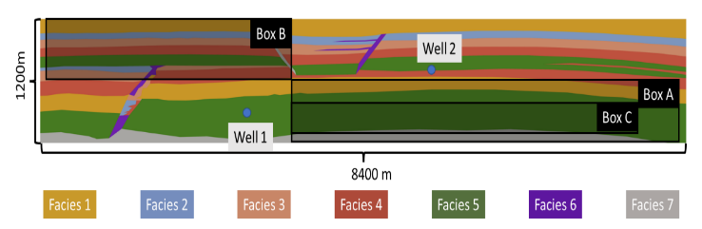 | 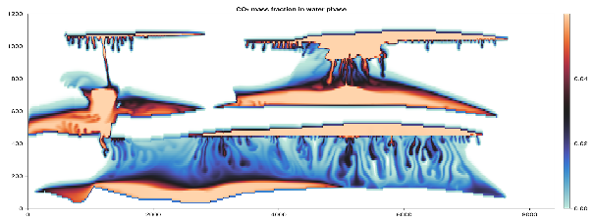 |
Figure 1: Distribution of lithological facies in the reservoir and locations of injection wells Well1 and Well2 (left), final distribution of CO2 dissolved in water as calculated by the IFPEN simulator: Geoxim (right)
A total of 45 research groups from academia and industry signed up to the initiative. The simulators were compared on the basis of both their physical results (mass of CO2 in the reservoir, amount of CO2 dissolved in water, temperatures, etc.) and their numerical performance (time step sizes, cumulative number of iterations of the nonlinear solver and the linear solver). Of these teams, only 18 - including IFPEN with the Geoxim simulator - ultimately contributed results to the comparative study [2]. IFPEN thus distinguished itself by presenting results that were cited on several occasions as benchmarks, notably as median results for one of the three cases studied.
This benchmark made it possible to evaluate Geoxim's performance, both in terms of the quality of the solutions obtained and in terms of numerical efficiency, for both linear and nonlinear solvers. Now widely adopted by the scientific community, the SPE11 benchmark serves as a standard tool for validating our code developments. It allows us to evaluate the robustness and precision of our new numerical schemes [3], as well as the quality of our meshing algorithms and modeling choices [4].
References:
[1] Nordbotten, J. M., et al. (2024). The 11th Society of Petroleum Engineers Comparative Solution Project: Problem Definition. SPE Journal, 29(5), 2507–2524.
>> DOI : https://doi.org/10.2118/218015-PA
[2] Nordbotten, J. M., et al. (2025). Benchmarking CO₂ Storage Simulations: Results from the 11th Society of Petroleum Engineers Comparative Solution Project. International Journal of Greenhouse Gas Control, 148, 104519.
>> DOI : https://doi.org/10.1016/j.ijggc.2025.104519
[3] Application of Convergent Finite-Volume Methods on Polyhedral Grids for CO2 Injection Simulation in Deep Saline Aquifers, L. Astart, S. de Chaisemartin, C. Delage, G. Enchéry, I. Faille; IFPEN. ECMOR 2026, 8-11 September 2026, Porto, Portugal.
[4] Modeling of Hydrate Formation in CO2 Geological Storage - Application to The 11th SPE Comparative Solution Project, E. Flauraud, D. Ding, A. Michel, IFPEN. SPE Reservoir Simulation Conference , Galveston, Texas, USA, March 2025.
>> DOI : https://doi.org/10.2118/223858-MS
Scientific contacts: Eric Flauraud, Anthony Michel, Guillaume Enchery