Fundamental Research
News
12 October 2026



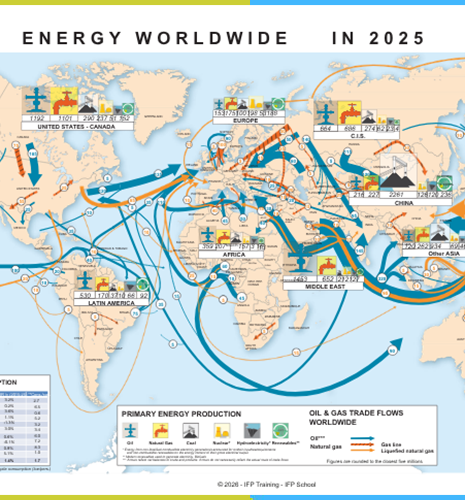
For nearly thirty years, IFP School and IFP Training have been collaborating on the creation of the energy flows map, which provides an overview of changes in energy mixes and trade between regions of the world. This new edition, based on 2025 data provided by leading international organizations—the Energy Institute, OPEC, and Eurostat—highlights the rapid transformations in energy trade over the past year. L’année 2025 a été marquée par deux tendances majeures, et concomitantes : tout d’abord, la baisse continue des importations européennes de pétrole et de gaz naturel en provenance de Russie, en ligne avec le plan d’arrêt des importations d’ici à l’automne 2027. Si cette dépendance s’est réduite du fait d’un hiver relativement doux et d’une réduction pilotée de la consommation de gaz en Europe ; elle s’est aussi déplacée vers une dépendance aux importations de gaz naturel liquéfié, en particulier provenant des États-Unis. C’est de ce côté de l’Atlantique que provient le second fait saillant de 2025 : les États-Unis poursuivent leur « expansionnisme énergétique » en ligne avec « l’American Energy Dominance Agenda » porté par l’administration américaine. Les exportations nettes de gaz naturel vers l’Europe ont augmenté de près de 70 % par rapport à 2024. La carte illustre en outre le rôle du Moyen-Orient, qui apparaît comme un carrefour d’échanges énergétiques incontournable… à l’origine des nombreuses turbulences sur les marchés de l’énergie en 2026.

The development of electric vehicles has been accompanied by technological advances resulting in more compact and higher-speed motors (rpm), which create significant heat fluxes within reduced volumes. This leads to the emergence of critical zones in terms of material integrity. Direct cooling by oil jets applied to localized regions appears to be a promising solution to this issue, but remains challenging to simulate numerically. Indeed, the resulting flows are characterized by high Prandtl numbers and, consequently, a very thin thermal boundary layer, particularly in the jet impingement zone, where cooling is most effective. As a result, in Computational Fluid Dynamics, explicitly resolving this boundary layer in large-scale geometries requires very fine meshes and often prohibitive computation costs.