
19.03.2026
3 minutes of reading


Faujasite Y zeolites (FAU-Y) have long been essential catalysts in the refining industry and show promising potential for the valorization of bio-based products. A collaborative paper published in the prestigious scientific journal Nanoscale, entitled “On the properties and origin of mesopore morphologies in dealuminated Faujasite Y zeolites” sheds new light on the structural and textural transformations of zeolites during post-synthesis treatment. These treatments are designed to optimize the properties of zeolites, particularly the formation of “molecular highways” such as channeling mesopores, which facilitate the access of target molecules to the active catalysis sites.
Scientific collaboration serving fundamental research
This research was conducted as part of Valentina Girelli Consolaro’s PhD thesis, funded by IFPEN, and in collaboration with the Joint Research Laboratory for the Characterization of Materials for New Energies (CARMEN). It was carried out at the Institut de Physique et Chimie des Matériaux de Strasbourg (Strasbourg Institute of Materials Physics and Chemistry) and supervised by Professor Ovidiu Ersen. For the past two decades, IFPEN has been working closely with the IPCMS advanced electron microscopy team on three-dimensional imaging and in-situ characterization of catalytic systems at the nanoscale.
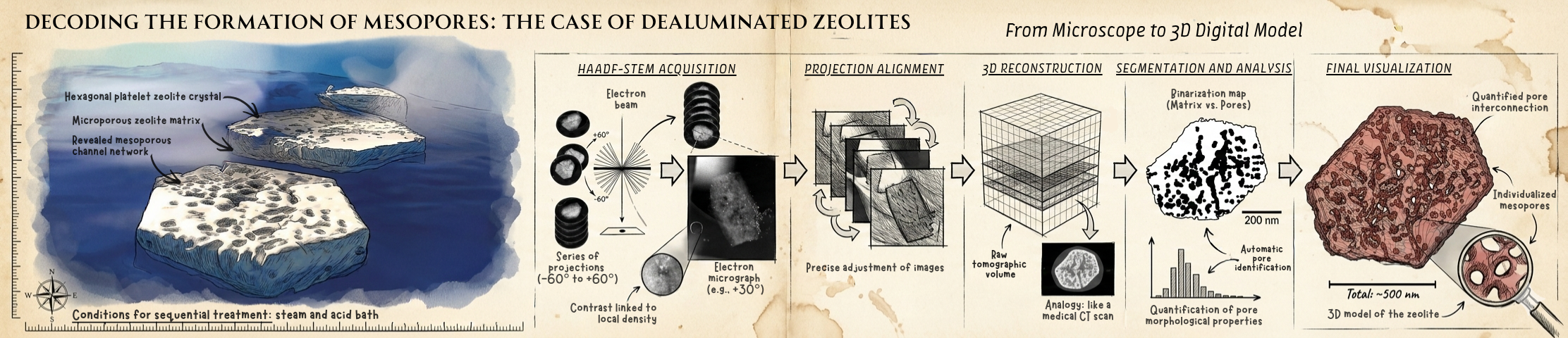
A unique perspective thanks to 3D electron microscopy
To decipher the mechanisms underlying mesopore formation, the researchers employed a quantitaivee approach combining imaging, advanced data processing, and modeling. Among the tools used, electron tomography proved invaluable. This innovative technique makes it possible to reconstruct the volume of the object examined in its entirety, thereby revealing its internal structure with nanometric precision, using a transmission electron microscope (3D TEM).
The analyses identified four main types of mesopores and proposed a formation mechanism based on nucleation and diffusion phenomena guided by the zeolites' native crystal defects. These results provide unprecedented insight into the effects of the dealumination process, which involves removing aluminum atoms from the zeolite crystal structure in order to adjust key properties such as acidity, molecular transport, and thermal stability.
These recent insights open up new avenues for optimizing the formation of mesopores within Y-Faujasites, thereby improving their catalytic performance.
1 By Valentina Girelli Consolaro, Virgile Rouchon, Walid Baaziz, Adam Hammoumi, Tom Ferté, Gerhard Pirngruber, Maxime Moreaud and Ovidiu Ersen
>>To read the complete article, : On the properties and origin of mesopore morphologies in dealuminated Faujasite Y zeolites.
You may also be interested in
Faujasite zeolite: a new generation is born
THESIS OF CÉLINE PAGIS, YVES CHAUVIN PRIZE 2019