
19.03.2026
3 minutes of reading


Understanding how the structure of a catalytic support determines its diffusion properties is crucial for improving the overall efficiency of heterogeneous catalytic processes. To address this challenge, the PhD research conducted by Stefano Collins [1], within the framework of a collaboration between IFP Energies nouvelles and the University of Nottingham, employed a novel combination of cutting-edge experimental characterization techniques, making it possible to study the influence of structure on mass transfer in the gaseous state at various scales in meso/macroporous gamma alumina materials.
Improved design for catalyst supports
Gamma alumina is very widely used as a catalyst support due to its mechanical properties, thermochemical stability, and textural properties. However, its complex and disordered structure makes it difficult to characterize, particularly with regard to mass transfer, a key parameter for optimizing catalytic performance.
In heterogeneous catalytic reactions , there is also a compromise between high specific surface area (favored by fine pores) and increased diffusion efficiency (which requires larger pores). The addition of controlled macroporosity could therefore provide reagents with faster access to the catalyst, while maintaining a large mesoporous surface area.
Stefano Collins’s PhD work [1] lies at the interface between these two areas of interest. The research evaluated the effectiveness of controlled macroporosity using advanced characterization methods and multi-scale models to establish a link between the structural and diffusion properties of gamma-alumina supports. It thus pushed back the boundaries associated with traditional methods by developing innovative analytical tools to improve the design of catalyst supports.
Experimental study
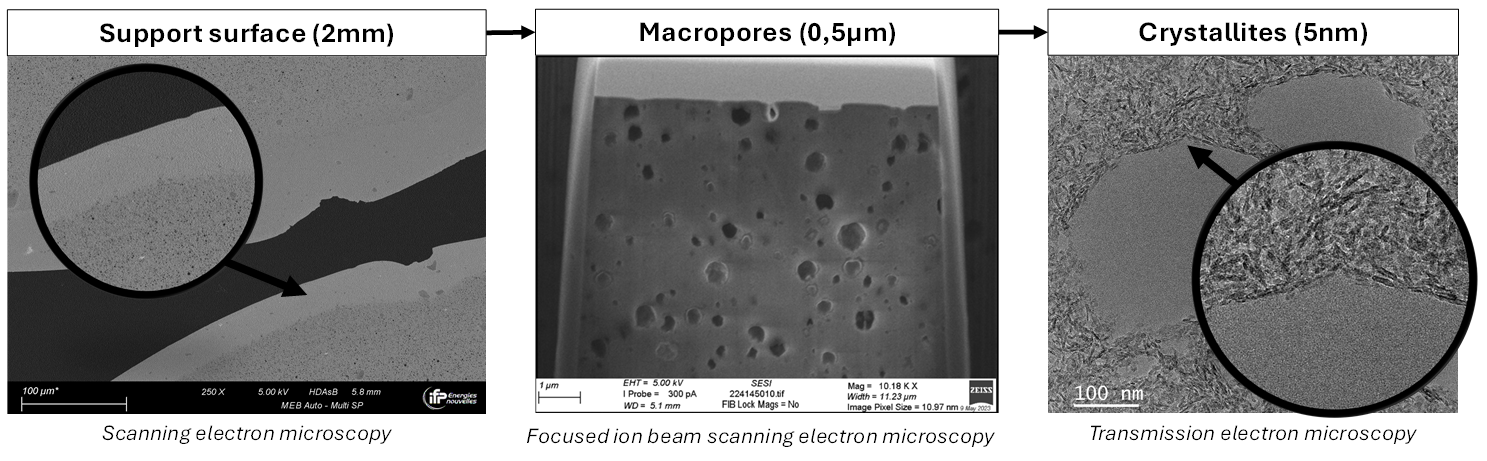
The study focused on cylindrical gamma-alumina pellets manufactured with varying porosity levels achieved through the addition of a porogen . Their structural characterization was performed using various electron microscopy techniques (SEM, SEM-FIB and TEM), which revealed heterogeneous organizational patterns at different scales (figure 1): 1) at the pellet scale, the presence of a dense crust that may limit access of reactants to the core of the catalyst, 2) a heterogeneous macropore size, 3) a nematic arrangement of alumina crystallites around the macropores that could potentially act as a diffusion barrier. In addition, pore size measurements were conducted using standard techniques such as nitrogen physisorption and mercury porosimetry.
Characterizations of mass transfer in the gaseous state were then performed by measuring the diffusion of sulfur hexafluoride (SF6), followed by pulsed-field gradient NMR, and by tracking the transport of hyperpolarized xenon using MRI [2]. This technique revealed significant variations in gas absorption rates at the 2D scale of the pellets, thereby demonstrating the impact of the structural heterogeneities observed. Nevertheless, based on the diffusion coefficients of SF6 under Knudsen conditions, mesopores dominate mass transfer, while macropores contribute little to it, even though they increase porosity.
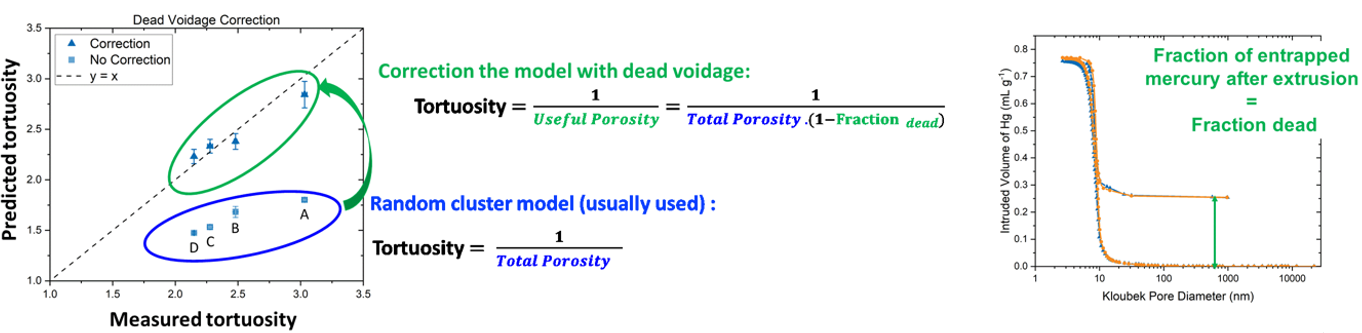
Finally, NMR cryodiffusometry was used to study the diffusion of liquid water within the total sample volume and pore subsets [3]. Thus, a tortuosity value can be obtained by dividing the reference intrinsic diffusivity of water at a given temperature by the measured confined intrinsic diffusivity. This value represents the ability of molecules of interest to diffuse through the porous network and thus enables the resistance to mass transfer to be quantified. Among the theoretical and empirical models applied, the Random Cluster Model (RCM) demonstrated that tortuosity is inversely proportional to porosity. However, “dead voidages” or useless porosities - which do not contribute to mass transfer - were identified and quantified using mercury porosimetry. The latter revealed that mercury becomes trapped in poorly connected regions of the porous network. Modifying the RCM to include these dead voidages enabled accurate predictions of tortuosity (Figure 2).
Ultimately, it was observed that the introduction of controlled macroporosity leads to an overall improvement in mass transfer, although the macropores create areas of low connectivity and “dead voidages,” resulting in reduced effectiveness and requiring further optimization of the catalytic support structure.
A multi-technique approach to porous materials
To sum up, this research demonstrates the importance of a multi-technique approach to characterize complex porous materials. The identification of dead voidoges and their impact on tortuosity underlines the need for a detailed characterization of pore connectivity. The combination of advanced techniques and robust theoretical frameworks opens up promising opportunities for the design of efficient catalytic supports, with direct applications for industry, IFPEN Group in particular. The findings also contribute to fundamental research on porous materials.
1 Heterogeneous catalysis is a type of catalysis in which the phase of the catalyst differs from that of the reactants or products. Generally, the catalyst is solid and the reactants are gases or liquids.
2 The porogen, also known as a template, is introduced in the form of an emulsion stabilized by a surfactant and is then removed by calcination, thereby creating porosity, specifically macropores.
3 Focalized Ion Beam
4 Preferential alignment of crystallites in a single direction
5 In the case of a gas, the molecules are relatively distant from each other. In this case, collisions with the pore walls may occur more frequently than collisions between the molecules themselves. This results in a decrease in the effective diffusion coefficient. This is known as Knudsen diffusion.
6 Combination of cryoporometry and pulsed-field gradient NMR
7 Tortuosity provides a measure of the distance traveled through a medium by calculating the average time it takes for a molecule to pass through it. Geometrically, tortuosity is the ratio of the average path taken by the molecule through the network to a straight line.
References :
[1] S. Collins, New insights into the structure-transport relationship of γ-alumina solids through an innovative multi-technique approach, PhD Thesis, University of Nottingham , 14302628 , 2025
[2] S. Collins, S. Humbert, D. Lofficial, C. Vallee, C. Parmenter, H.E.L. Williams, A. Harrison, M. Filkins, G.E. Pavlovskaya, T. Meersmann, S.P. Rigby, Hyperpolarized Xenon-129 MRI, Fluorine-19 PFG NMR, SAXS and electron microscopy studies of the impact on structure and gas phase mass transport of introducing controlled macroporosity into mesoporous, alumina, catalyst support pellets, Chemical Engineering Science 321B (2026) 122843.
>> DOI = https://doi.org/10.1016/j.ces.2025.122843
[3] S. Collins, D. Lofficial, S. Humbert, T. Chevalier, C. Vallee, H.E.L. Williams, G.E. Pavlovskaya, T. Meersmann, S.P. Rigby, NMR Cryodiffusometry Determination of Pore Utility Differentials for Liquid-phase Diffusion within Alumina, Catalyst Support Pellets, Chemical Engineering Science (2026), 123752
>> DOI = https://doi.org/10.1016/j.ces.2026.123752
Scientific contact : Dina Lofficial
You may also be interested in
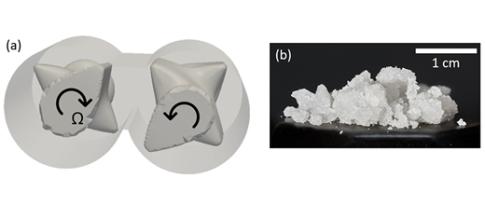
SC5 - Manufacture of catalytic supports: a new parameter for controlling the kneading of boehmite pastes
Processes using heterogeneous catalysis require the design and development of innovative materials, with controlled mechanical and textural properties, to produce effective catalyst supports. The porous microstructure of these supports has a significant impact on the performance of the supported catalyst, since it strongly affects the support’s mechanical resistance and transport phenomena...