



Setting a course in the face of pressure on water resource
- By 2030, global water demand could exceed supply by 40% (UN).
- Water stress is already a reality: 2.5 billion people are affected.
The challenge is multifaceted: to meet the needs of the population, to secure essential uses, and to preserve aquatic environments in the long term. The emergence of new pollutants and the complexity of certain environments require:
- the development of water treatment, depollution, and reuse technologies adapted to local contexts;
- the establishment of precise regulations on these new pollutants, essential conditions for accelerating the industrialization of technologies and meeting the growing water-related challenges.
 Download the flyer (PDF - 660 Ko)
Turning research into operational solutions
In collaboration with industrial players, SMEs and start-ups, IFPEN co-develops innovative technologies to address concrete issues faced by water stakeholders, by mobilizing its expertise and testing capabilities to assess, qualify, and deploy them on a large scale.
CleanWash, a technology developed by IFPEN, captures plastic microfibers at the source during professional textile washing. Successfully tested, it has eliminated more than 90% of microfibers in real conditions.
>> CleanWash: IFPEN innovates to capture plastic microfibers from professional textile washing
Video: Sustainable water management - IFPEN's solutions
Treating emerging pollutants
Microplastiques
- The Rock-Eval® tool allows rapid identification and quantification of microplastics present in samples collected from water or soil.
Access IFPEN publications
- Cleanwash captures more than 90% of microplastics from professional textile washing (successfully tested with the support of the CTTN/IREN, Research Institute for maintenance and cleaning) , and 5àSec).
PFAS
- Capture solutions by innovative foam fractionation or solid-adsorbent have been developed, targeting a wide range of molecules, including short-chain PFAS.
- Destruction solutions, to be developed through new partnerships, make it possible to fully destroy PFAS, with technologies adapted to different types of contaminated waters.
Focus: advanced flotation technology
The advanced flotation system developed by IFPEN separates fine particles, including microplastics. Used as a pretreatment for membranes, it helps to limit maintenance costs. For certain emerging pollutants, it is a complementary step to be combined with other processes depending on the quality of the water to be treated.
Other types of pollution addressed
- Deoiling: greases, oils, hydrocarbon pollution
- Dissolved metals: capture and recovery processes
Bio-based and biodegradable bioproducts are also being developed to reduce the environmental footprint of water treatment processes.
Explorer les opportunités de co-développement avec IFPEN

Basing innovation on scientific and technical expertise
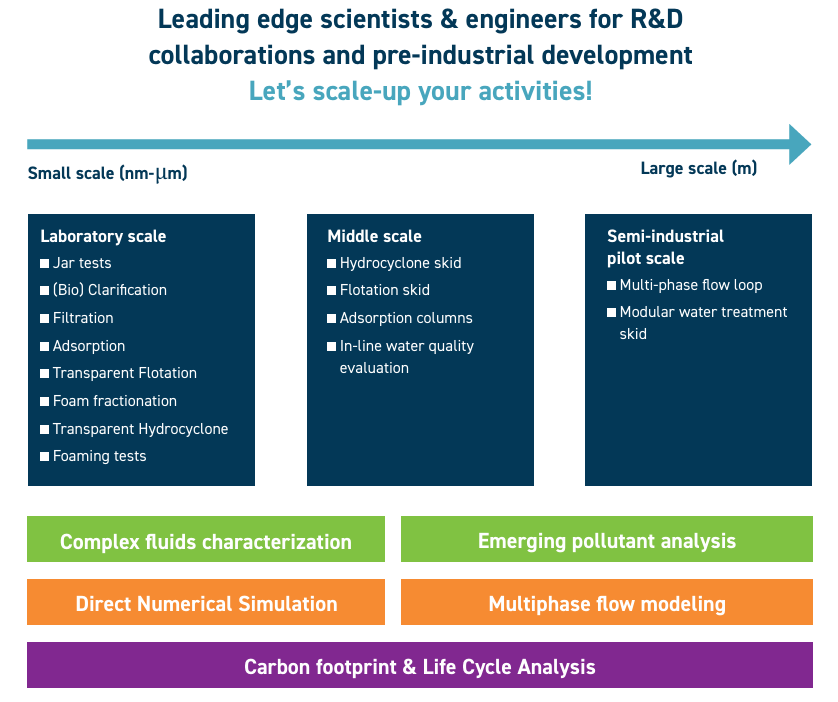
IFPEN relies on research supported by a Carnot platform dedicated to water treatment. Its know-how and multidisciplinary skills (experimental and modeling), resulting in particular from the treatment of complex industrial waters within its historical hydrocarbons activities, allow it to:
- identify and solve field issues faced by water stakeholders
- translate them into application-oriented and scale-up solutions
>> Yves Chauvin Prize 2025: meet the laureate, Nicolas Fintzi
Measurable impacts
• Effectiveness: targeted clean-up of polluted waters.
• Sustainable innovation: direct contribution to SDGs 6, 13, and 14; reduction of risks related to droughts, floods, and resource scarcity.
Federating ecosystems together to accelerate the water transition
Innovating in water sector means working in partnership to benefit from the complementary of expertise. By cooperating with public players, industry, SMEs, start-ups and academic word, IFPEN builds bridges between research and industry and helps meet the challenges of the water transition.
What co-development with IFPEN enables
- access to high-level scientific and technical skills (experimental and modeling)
- develop high-performance solutions oriented toward on-site deployment
- assess the environmental impact through LCA
